


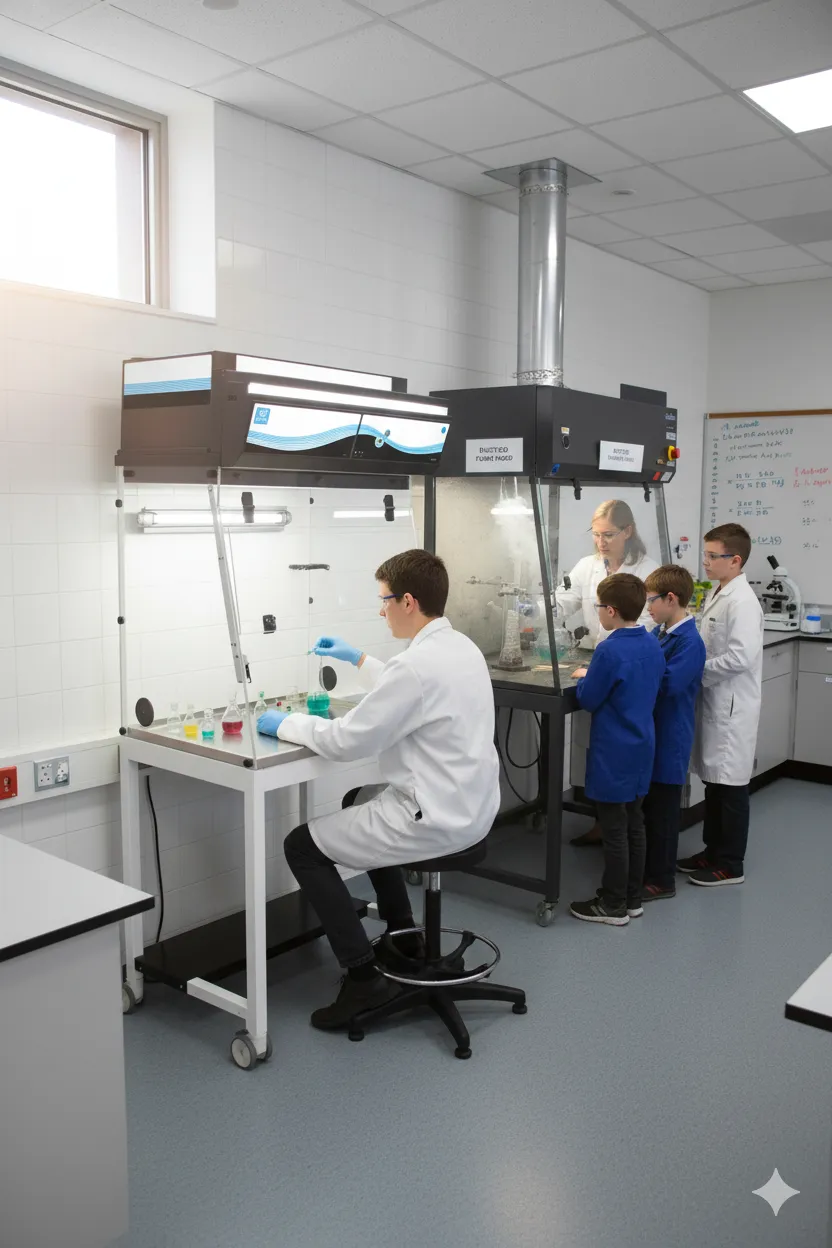
National Chemistry Week marks a fair time to revisit how we think about safety, budget, and the assumptions we’ve held for too long.
National Chemistry Week 2024 wrapped up last month with the theme “The Healing Power of Chemistry.” Labs across the country used it as time to showcase chemistry education, run public demonstrations, and think about how they’re actually teaching the next generation of chemists.
Walk through a teaching lab today versus 20 years ago, and something subtle has shifted. The equipment looks similar – benches, storage, ventilation. But the conversations happening around that equipment have changed completely.
20 years ago, if you mentioned ductless fume hoods in a university setting, you’d get immediate pushback. “Our EHS won’t allow them.” “Filters saturate.” “We only trust ducted exhaust.” That was the default position.
Today, those same institutions are evaluating ductless for specific applications. Not replacing everything at once, but recognizing that some teaching lab work fits ductless capabilities while other work still requires traditional exhaust. The question shifted from “why would we ever use ductless” to “where does ductless make sense for our specific applications.”
What changed? Several things, all at once.
Standards Caught Up With Reality
20 years ago, if you asked what standards governed ductless fume hood use, you’d get vague references to general lab ventilation guidance. NFPA 45, the fire protection standard for labs using chemicals, mentioned ventilation but didn’t explicitly address ductless systems in detail.
The 2024 edition of NFPA 45 changed that. Sections 7.15 and 7.16 specifically cover ductless fume hoods – installation requirements, procedures for use, and operational considerations. ANSI/ASSP Z9.5-2022 (the lab ventilation management standard) explicitly includes ductless hoods in its scope and defines monitoring requirements.
This matters because institutional EHS teams base decisions on standards. When standards were ambiguous about ductless, EHS defaulted to “no” because that’s the safe institutional answer. When standards provide clear guidance on appropriate use, validation requirements, and monitoring protocols, EHS can evaluate specific applications rather than making blanket policy decisions.
So, universities that banned ductless 20 years ago now have case-by-case approval processes. Schools that never considered ductless now evaluate it for teaching labs, powder weighing, and demonstration work.

Filter Technology Got Smarter
Early ductless systems relied on standard activated carbon filtration. The problem with standard activated carbon is that it works great for some chemicals and poorly for others. Polar compounds, low-molecular-weight solvents, and certain acid/base combinations challenged conventional filtration.
The last decade brought significant advances in molecular filtration. Erlab’s Neutrodine Unisorb technology, for example, can simultaneously handle solvents, acids, and bases with a single filter – something conventional activated carbon can’t do. The technology uses multiple filtration layers that transform molecules during adsorption, dramatically increasing retention capacity for traditionally difficult compounds like polar VOCs and low-boiling-point chemicals.
More importantly, validation improved. Erlab has documented over 700 chemicals with specific retention capacities, breakthrough detection methods, and projected filter lifecycles. That level of validation didn’t exist 20 years ago. Labs can now match specific teaching experiments to documented filter capabilities rather than guessing whether filtration will work.
The practical impact is that teaching labs can use ductless for applications that would have required ducted hoods a decade ago, simply because filters now handle a broader chemical spectrum with documented safety margins.
Monitoring Went From Periodic to Continuous
20 years ago, filter saturation monitoring meant manual testing – someone remembered to check breakthrough using detector tubes on some reasonable schedule. Maybe monthly. Maybe quarterly. The gaps between checks created uncertainty about when filters actually saturated.

Modern ductless systems integrate real-time monitoring. MoleCode sensors continuously track chemical breakthrough for specific compound classes. Anemometers monitor face velocity and alert when airflow drops. Temperature and humidity sensors log environmental conditions. All of this data streams to mobile apps and desktop dashboards, creating continuous compliance documentation without requiring staff to remember testing schedules.
For teaching labs, this shift eliminated a major objection. Instructors worried about students working in hoods with saturated filters because manual testing couldn’t catch saturation between checks. Automatic detection with immediate alerts solves that problem. When a filter approaches saturation, multiple people get notified before any safety margin erodes.
The documentation angle matters too. GMP pharmaceutical labs and CLIA clinical labs need continuous compliance records for audits. Equipment that logs every parameter, every alarm, and every filter change automatically satisfies documentation requirements that manual logging couldn’t reliably meet.
Teaching Labs Discovered Flexibility Matters More Than They Thought
Educational institutions face constraints that industrial labs don’t. Limited capital budgets. Changing enrollment. Evolving curriculum. Leased buildings where modifications aren’t allowed. Teaching labs that need to reconfigure every semester as course schedules change.
Ducted hoods solve the safety problem but create an infrastructure problem. Once you install ductwork and tie into building HVAC, that hood stays where you put it. Changing lab layout means construction, permitting, rebalancing, and budget you probably don’t have.
Ductless systems install in hours with standard electrical outlets. When your organic chemistry enrollment doubles and you need to add capacity, you can. When you’re moving to a new building, the hoods move with you. When you’re converting a classroom into a lab space, you’re not waiting months for ductwork installation.
Community colleges particularly benefited from this shift. Many community colleges operate in older buildings with limited HVAC capacity or in leased facilities where building modifications aren’t practical. Ductless gave these programs a way to offer hands-on chemistry training without capital-intensive construction projects.
High schools saw similar benefits. Chemistry programs that couldn’t justify the cost of ducted hood installation could now add containment for small-volume solvent work, demonstrations, and student experiments. The “chemistry class without fume hoods” problem became solvable with reasonable budgets.
Energy Awareness Became Unavoidable
20 years ago, energy costs existed but didn’t dominate facilities conversations. Today, “Shut the Sash” campaigns run at major universities. Sustainability offices publish energy consumption data for individual hoods. Students see signage comparing fume hood energy use to home energy consumption.
The numbers drive the conversation. Documented ranges show ducted fume hood operating costs between $3.70 and $7.40 per CFM per year, depending on climate and energy rates. A single hood exhausting 800 CFM continuously costs thousands annually just to condition the make-up air required to replace exhausted air.
That cost is often unavoidable when chemistry requires ducted exhaust. But teaching labs forced to ask “do we actually need exhaust for this specific experiment” discovered that many common teaching demonstrations use known chemicals in small volumes – exactly the profile where ductless makes sense.
The calculation changes when you eliminate exhaust. No exhaust means no make-up air. No make-up air means your HVAC system isn’t continuously heating or cooling outdoor air to replace what the hood exhausted. Filter replacement costs appear as new line items, but they’re predictable, budgetable, and in appropriate applications, substantially less than the energy penalty of continuous exhaust.
Winter amplifies this reality. When outdoor temperature is 15°F and your building needs to maintain 70°F, every cubic foot of exhaust air requires heating 55 degrees of temperature differential. December through February, fume hood operating costs peak. Teaching labs in cold climates feel this acutely – the hoods run continuously through the coldest months, exhausting expensive warm air and forcing heating systems to work harder.
Universities with aggressive sustainability goals found themselves caught between “labs need fume hoods for safety” and “we need to reduce building energy consumption.” Ductless for appropriate applications became one of the few tools that addressed both requirements simultaneously.
What Actually Works in Teaching Labs
The theoretical discussion about ductless capabilities matters less than what actually works in real teaching environments. Here’s what we’re seeing deployed successfully.

High school chemistry
Most high school experiments use small quantities of known chemicals – dilute acids, common solvents, routine demonstrations. A typical setup places two to three ductless hoods along a wall for student use, with each hood validated for the specific chemical list in the curriculum. Powder weighing stations use HEPA-filtered balance enclosures to prevent draft interference while capturing particulates.
The key advantage: schools can add chemistry capacity without construction. When enrollment grows or curriculum changes, adding ductless hoods takes hours instead of months. When budget cycles allow replacement, old hoods move to storage rooms or prep areas while new hoods go to primary teaching spaces.

Undergraduate organic chemistry labs
Organic labs typically split between synthesis work (requiring ducted hoods for varied chemistry and heat) and characterization work (small-volume sample prep for instruments). A functional layout might place four ducted hoods along one wall for synthesis and distillations, with four ductless hoods opposite for sample preparation, TLC work, and chromatography column packing.
This split lets students work on both sides of the lab without competing for limited ducted capacity. Routine tasks that don’t generate heat or use large volumes move to ductless hoods, preserving ducted capacity for applications that truly need exhaust.

Community college programs
Community colleges often operate in buildings with HVAC systems designed for classrooms, not labs. Adding significant ducted hood capacity would require HVAC upgrades the budget can’t support. A typical solution: minimal ducted capacity (one or two hoods) for demonstrations and instructor-supervised work, supplemented with ductless hoods for student use in controlled experiments.
This approach lets community colleges offer laboratory training that would otherwise be impossible. Students get hands-on experience with containment equipment, proper technique, and chemical handling – but within a chemical scope that matches ductless capabilities.
Where Ductless Still Doesn’t Belong
The expanded applications for ductless don’t change fundamental limitations. Some chemistry requires ducted exhaust, period. Institutional policies recognizing this have become more sophisticated rather than less restrictive.
Perchloric acid digestions need dedicated wash-down ducted hoods. Hot acid work needs ducted exhaust. Large-scale synthesis with significant heat generation needs ducted systems. Unknown chemistry where you can’t validate filtration needs ducted hoods. Any chemistry not validated through proper filter matching needs exhaust.
The smarter conversation happening now: “This specific experiment uses these specific chemicals in these quantities. Does that fit ductless capabilities with documented safety margins, or does it require ducted exhaust?” 20 years ago, the conversation often stopped at “we only use ducted hoods.” Today, EHS teams, lab managers, and instructors evaluate specific applications against specific capabilities.
Filter Selection Actually Makes Sense Now
Understanding which chemicals need which filters used to require deep technical knowledge that most lab managers didn’t have. The validation gap created uncertainty: “Will this filter actually work for our chemistry, or are we guessing?”
Modern filter selection starts with chemistry profiling. Labs submit their chemical lists – what compounds, what quantities, what usage frequency. Manufacturers (Erlab specifically) analyze that list against validated retention data for 700+ chemicals and provide specific filter recommendations with documented capacities and projected lifecycles.
The analysis considers chemical classes and interactions. Solvents, acids, and bases each challenge filtration differently. Some chemicals rapidly saturate conventional carbon. Others require specialty formulations (formaldehyde needs specific pre-treatment; ammonia needs specialized carbon). When multiple chemical classes appear in the same workspace, filter selection must account for all of them simultaneously.
This level of matching wasn’t standard practice 20 years ago. Labs installed ductless with generic carbon filters and hoped for the best. Today, filter specifications match documented chemical profiles, eliminating guesswork and providing defensible safety margins.
For teaching labs, this means curriculum planners can work backward from desired experiments to equipment specifications. “We want to teach these five experiments using these chemicals” becomes a question with a documented answer: either “yes, these filters handle that chemistry with this much capacity” or “no, that experiment requires ducted exhaust.”
The Layout Decisions That Actually Matter
Lab layout for ductless integration isn’t about maximizing ductless usage – it’s about matching applications to appropriate containment.

Split-use research labs
Labs running varied research projects often can’t predict all chemicals in advance, which makes comprehensive ductless deployment inappropriate. But even these labs have predictable tasks. A typical layout places ducted hoods along the main bench run for synthesis and varied chemistry work, with ductless hoods in adjacent spaces for powder weighing, solvent dispensing from stock bottles, and chromatography column work.
This preserves ducted capacity for applications that need it while offloading routine tasks to ductless containment.

QC and analytical labs
Quality control labs often handle the same chemicals repeatedly – sample extraction, standard preparation, calibration work. These repetitive workflows match ductless capabilities perfectly. A functional layout might position ductless hoods around the perimeter for sample prep and extraction work, with a single ducted hood in a separate prep room for occasional tasks outside the normal chemical scope.
The key: QC labs know their chemical inventory and can validate that inventory against filter capabilities. Unknown samples arriving daily wouldn’t fit this model, but routine testing of known products does.

Teaching lab reconfigurations
Many teaching labs renovated in the last decade kept existing ducted capacity (expensive to remove, and you need some ducted hoods anyway) while adding ductless capacity where enrollment or curriculum changed. A school might keep four ducted hoods in the synthesis section while adding six ductless hoods in what was previously dry lab space, doubling student capacity without doubling infrastructure costs.
The flexibility matters during semester transitions. Ducted hoods stay where they are. Ductless hoods move between rooms as course schedules change.
What National Chemistry Week Actually Highlights
National Chemistry Week exists to showcase chemistry’s positive impact and inspire the next generation of chemists. The theme changes annually, but the underlying goal stays consistent: make chemistry accessible, relevant, and engaging.
Teaching that chemistry safely, in facilities that can actually accommodate hands-on training, requires equipment choices that match institutional reality. Limited budgets, aging infrastructure, sustainability pressures, and enrollment growth all constrain what’s possible.
The shift over the last decade – from reflexive rejection of ductless to thoughtful evaluation of appropriate applications – reflects maturity in how the field thinks about laboratory safety equipment. Not ideology, not vendor preference, but application-specific assessment of whether containment capabilities match chemical hazards.
That’s the conversation worth having during National Chemistry Week. Not “ductless versus ducted” as a binary choice, but “which tool for which job, and how do we deploy both appropriately.” Teaching labs that figured this out now have flexibility, capacity, and safety margins that weren’t possible 20 years ago.
The labs that haven’t figured it out yet are still running the same conversations they ran a decade ago – wishing they had more capacity, frustrated by energy costs they can’t control, and wondering why their HVAC system can’t keep up with fume hood demands during winter.
The difference between those two situations isn’t luck. It’s understanding what changed, what’s possible now that wasn’t possible before, and where to deploy different technologies for different applications.
Chemistry education works best when safety doesn’t force compromises on access. Getting there requires equipment that matches both the chemistry you’re teaching and the constraints you’re operating under.
