



The slow damage from repetitive weighing – and what it takes to prevent both inhalation exposure and musculoskeletal injury
Your analytical chemists are getting hurt. Not dramatically – no chemical burns, no emergency evacuations. Just slowly. The analyst who weighs powders for eight hours develops a persistent cough. The QC tech hunches over the balance and goes home with chronic neck pain. The method development chemist inhales trace amounts of API dust daily for months.
Weighing stations in pharmaceutical labs present a dual hazard that most facilities address incompletely. You solve for airborne exposure with containment but ignore ergonomic strain. Or you optimize for comfort but accept exposure risk. The analysts pay for this incomplete solution with their long-term health.
The Dual Problem. Exposure and Ergonomics
| Inhalation Exposure | Ergonomic Strain |
|
The invisible accumulation. Pharmaceutical powders create airborne particles during every transfer. You can’t see them, can’t smell them, won’t know you’ve been exposed until symptoms appear weeks later. Most compounds have exposure limits measured in micrograms per cubic meter. High-potency APIs require containment below 1 microgram per cubic meter. At those levels, traditional open balance setups expose analysts continuously through normal air movement. Long-term effects: Respiratory sensitization, systemic absorption, organ damage that shows up after years of exposure. |
The cumulative strain. Analysts lean forward to read displays, reach across surfaces to place samples, crane necks to see through draft shields, maintain awkward postures because workstation height doesn’t match body dimensions. Standard 36-inch bench height forces shorter analysts to reach up, taller analysts to hunch down. Neither posture is sustainable for hours of repetitive weighing. Long-term effects: Chronic neck pain, shoulder injuries, carpal tunnel syndrome, musculoskeletal disorders from sustained awkward postures. |
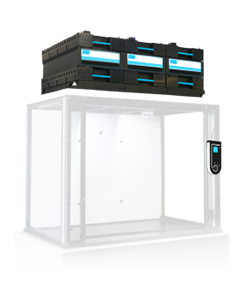
Critical Specs for Enclosures
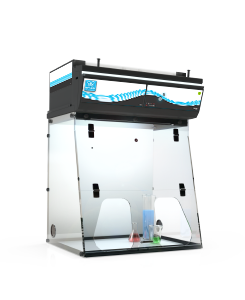
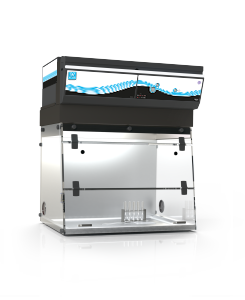
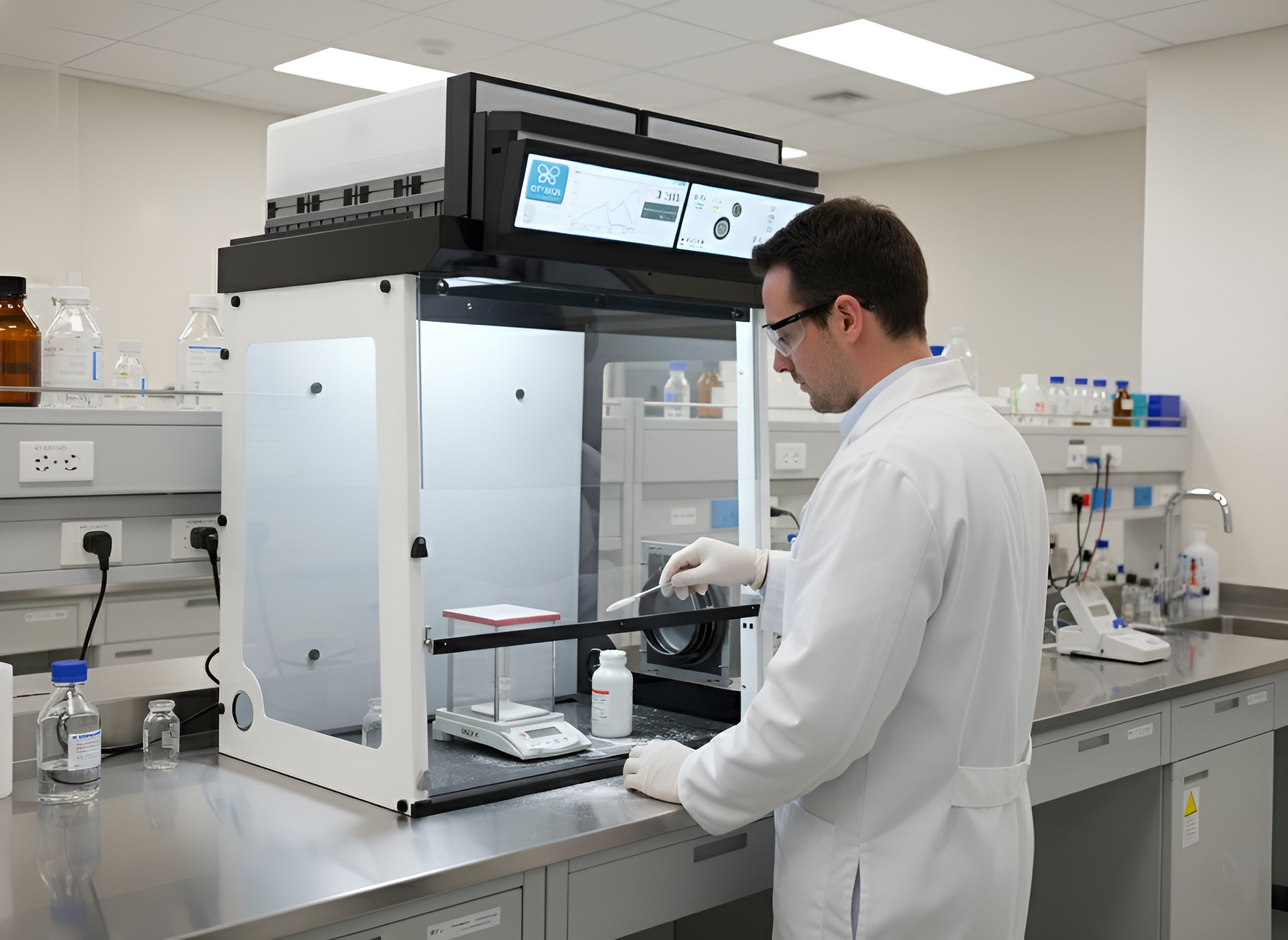
An enclosure that captures 99.995% of particles but forces analysts into sustained awkward postures has failed. Effective weighing enclosures address both hazards simultaneously.
| Feature | Why It Matters |
| HEPA H14 filtration minimum | 99.995% particle capture at 0.1 micrometers. High-potency compounds require ULPA filtration (99.99995%). |
| Negative pressure maintenance | Continuous airflow monitoring with alarms prevents contaminated air from escaping the work zone. |
| Validated containment | ISO 14644-7 and ASHRAE 110 testing under real weighing conditions – opening containers, transferring powders, cleaning spills. |
| Adjustable work surface height | Analysts range from 5’0″ to 6’4″. Fixed height creates awkward postures. Adjust to elbow height (38-44″ for standing, 28-32″ for seated). |
| Low-profile design | Minimizes distance between analyst’s eyes and balance display. Reduces neck flexion. Allows neutral head position. |
| Adequate depth and width | Minimum 24″ depth, 36″ width prevents excessive forward reach. Balance positioned near front, samples within easy reach. |
| Integrated task lighting | Adjustable LED lighting (750-1500 lux) eliminates glare, reduces eye strain, prevents neck craning to see clearly. |
| Breathing zone positioning | Analyst’s nose and mouth stay outside enclosure or in clean filtered air. Prevents leaning into contaminated zone to read display. |
Workstation Setup to Reduce Strain
Perfect equipment fails if workstation setup creates problems. The enclosure, balance, support equipment, and surrounding environment form a system.

Work surface and balance positioning:
- Adjust height to analyst’s elbow height (not one-size-fits-all)
- Position balance near front of enclosure to minimize forward reach
- Place display at eye level, 20-26 inches from face
- Organize samples and tools within easy reach – most-used items closest
Flooring and seating:
- Anti-fatigue matting (3/4″ thick minimum) for standing work
- Laboratory chairs with adjustable height, lumbar support, and armrests for seated work
- Feet flat on floor, thighs parallel to floor when seated
Lighting and documentation:
- General lab lighting: 500-1000 lux at work surface
- Task lighting: additional 750-1500 lux without glare
- Computer screens directly in front at eye level, 20-26 inches away
- Document holders at same angle as screens to prevent repeated up-down head movement
Training Staff on Best Practices
Training on weighing operations typically covers analytical technique and contamination control. It rarely covers ergonomics or exposure prevention beyond “wear your PPE.” Effective training addresses why certain practices reduce long-term health risks and how to perform tasks that minimize exposure and strain.
Initial setup (train before first use):
- Adjust work surface height to individual elbow height
- Position balance for minimal reach
- Organize tools to minimize reaching and twisting
- Verify viewing angles allow reading display without head tilting
Exposure reduction techniques:
- Slow, controlled movements to prevent air currents that disperse particles
- Open containers slowly, keep opening away from breathing zone
- Minimize powder transfer distance
- Clean with damp wipes that capture particles, not brushing that disperses them
Posture and fatigue management:
- Recognize and maintain neutral spine position
- Relax shoulders deliberately during precise work
- Take 30-60 second micro-breaks every 20-30 minutes
- Rotate tasks when possible to use different muscle groups
- Recognize early warning signs: muscle fatigue, stiffness, reduced coordination
PPE considerations:
- Select thinnest glove compatible with exposure risk
- Fit safety glasses properly to avoid head tilting
- Ensure lab coats fit to prevent uneven weight distribution
Measuring Improvement Over Time
Without measurement, you don’t know if changes actually reduced injuries and exposure. The goal isn’t to implement interventions. The goal is to reduce long-term health damage. Measurement proves whether you’ve achieved that goal.
Exposure monitoring:
- Personal sampling in analyst’s breathing zone during typical operations
- Area sampling near workstation to verify containment
- Surface wipe sampling on touched surfaces
- Frequency: quarterly for high-potency compounds, annually for lower-potency
- Immediate sampling after equipment changes or increased symptoms
Injury and symptom tracking:
- Quarterly symptom surveys (use validated tools like Nordic Musculoskeletal Questionnaire)
- Body maps showing where analysts experience discomfort
- Restricted duty days tracking
- Workers compensation claims patterns
Operational metrics (are interventions being used?):
- Workstation adjustment frequency
- PPE compliance rates
- Cleanup procedure compliance
- Maintenance completion rates

Before/after comparison: Establish baseline before changes, measure same parameters after implementation. Exposure reductions appear immediately in air sampling. Symptom improvements appear within weeks to months. Injury rate reductions require 1-2 years because existing injuries continue developing.
If metrics show no improvement: Either intervention was implemented incorrectly, you addressed the wrong hazards, or analysts aren’t using interventions as intended. Continued measurement identifies the problem.
Partial Protection Isn’t Protection
Labs that focus on exposure control while ignoring ergonomics see declining acute exposure events but increasing musculoskeletal disorders. Their respiratory protection works, but analysts develop chronic neck pain, shoulder injuries, and carpal tunnel syndrome.
Labs that optimize ergonomics while accepting exposure risk see comfortable analysts who later develop respiratory sensitization, systemic toxicity, or chronic lung disease from cumulative pharmaceutical powder exposure.
Both approaches fail.
The analysts who weigh powders daily for years face both hazards simultaneously. They need equipment, workstation design, and procedures that address both. Containment without ergonomic design creates comfortable breathing and painful joints. Ergonomic design without containment creates comfortable posture and damaged lungs.
Your analytical chemists will spend thousands of hours at weighing stations over their careers. The choices you make about their work environment determine whether those hours cause cumulative damage or whether they can sustain productive work without sacrificing their long-term health.
The difference between those two situations isn’t luck. It’s understanding what changed, what’s possible now that wasn’t possible before, and where to deploy different technologies for different applications.
Chemistry education works best when safety doesn’t force compromises on access. Getting there requires equipment that matches both the chemistry you’re teaching and the constraints you’re operating under.
