




Introduction
Nearly a year since the start of the pandemic, it is difficult to step out of your home and not worry about air quality. Every mask or social distancing marker is a reminder that the air we breathe may pose a danger to our health.
With the release of the COVID-19 vaccine, we are beginning to glimpse a path back to normalcy: a world where we can visit loved ones, celebrate birthdays, and re-open businesses that have had to shut their doors in the interest of public health. It is important to remember, however, that vaccination will not eliminate all airborne dangers. We are already seeing new strains of the Coronavirus and are faced with the unsettling possibility that normalcy is still a ways off.
Airborne virus transmission is likely to remain a serious health concern for a long time to come. Add to that the ongoing and alarming growth of air pollution, and it becomes clear that we need a long-term plan to maintain healthy air quality, particularly in commercial spaces where large numbers of people may gather.
Airborne Risk
Though we are mainly concerned with mitigation strategies for SARS-CoV-2, there are additional risks that were a part of our everyday lives well before the global pandemic. These risks, though unseen, pose a significant health threat both pre- and post-COVID-19.
Aerosolized Virus Transmission
There are many ways that a virus is transmitted, but airborne aerosolized droplets are the primary form of spread. When these microsized droplets are released, they remain suspended in the air for several hours (or longer). Even worse, they are recirculated through a building’s ventilation via the return and supply vents.
Unfortunately, these tiny droplets wreak havoc on our bodies—particularly our respiratory systems—as they are inhaled deep into our lungs. Our bodies are incapable of filtering these tiny particles out, leading to lower respiratory tract infections and increasing the severity of the disease.
However, because these droplets are so small, there has to be a fairly high “viral load,” or concentration, of droplets for transmission to occur. This will affect every individual differently, which means that we can never truly know what a safe environment is. Therefore, the best course of action is to put proper air treatment solutions in place to ensure cleaner, safer air for everyone.

Everyday Dangers

While our attention has been on the risk of aerosolized viral transmission, it should not be our only concern. Every day, we are exposed to hidden dangers that impact our health. These are called PM 2.5 (particulate matter at 2.5 microns or less in width).
Similar to airborne viruses in size, PM 2.5 particles have a significant impact on our overall health. In fact, they contribute to over 7 million premature deaths worldwide every year. Poor air quality is truly a silent killer that needs to be addressed. The majority of our exposure to concentrated PM 2.5 is in our homes, offices, gyms, and other public spaces. Most ventilation is inadequate and propagates these pollutants, increasing the concentrations we are exposed to rather than filtering them out.
Before the pandemic, indoor air quality (IAQ) was a known problem, but it wasn’t a mainstream topic of discussion. COVID-19 revived debate of air quality issues that are quickly enveloping us. This is now a widely reported, serious subject we see in everyday media. We now read daily warnings regarding IAQ, poor ventilation, and the combined impact that both have on our everyday health. So, other than risk of viral transmission, what are the additional safety hazards associated with poor IAQ? Consider the 7 million premature deaths associated with poor air quality every year
More than 300,000 of those deaths are right here in the Americas.
Compare that to the 430,000 COVID19-related deaths we’ve seen in the United States over the past year.
It is safe to say that polluted air impacts our lives much like a pandemic.
The continuous exposure to polluted air weakens our immune systems and can severely affect our ability to fight off viruses —in particular, respiratory illnesses such as SARS CoV-2 and seasonal influenza.
So what are these pollutants and how do we know if we’ve been exposed? Unfortunately, there are many variables that make exposure difficult to identify. Additionally, these PM 2.5 pollutants are very fine, inhalable particles which are not always visible to the human eye. Examples include dust, ash, and soot.

During the wildfires that spread across California, Oregon, and Washington in early September 2020, the air quality was so poor that businesses had to shut down. Some care facilities had to evacuate due to the increase in pollution, which severely impacts those already compromised due to other underlying health conditions. While we are all concerned about how we can mitigate the risk of viral transmission, we also have to be very cognizant of the other invisible killers lurking in our homes, office buildings, and public places.
Mitigating Risk in Your Commercial Space
As we all discuss mitigation strategies, many are looking for guidance to determine the cost implications of mitigating risk.
The American Society of Refrigeration and AirConditioning’s (ASHRAE) positioning document on infectious aerosols states that the design and operation of HVAC systems can influence infectious aerosol transport, but they are only one part of infection control. Their positioning document on Indoor Air Quality (IAQ) and the CDC’s recommendation for ventilation in buildings outline the criteria that buildings should follow to improve IAQ and decrease the risk of viral transmission.

They provide several key recommendations:
-
Increase air change rates (ACH) and minimum outdoor airflow rates
-
Ensure proper air distribution, or dirty to clean directional airflow patterns
-
Increase air filtration within the ventilation without reducing design airflow, or decreasing the air change rates
-
Add HEPA filtered systems to enhance air cleaning
-
Use upper room UVGI as a supplement to aid in the mitigation of SARS-CoV-2
However, with upgrades, there are always challenges to consider. These include the impact integration could have on the building’s ventilation and, of course, costs.
Ventilation System Upgrades: High-Efficiency Filters
Let’s start with the option to upgrade to highefficiency filters. How effective are they and how can they impact the ventilation system? The use of high-efficiency particle filters (HEPA) or Minimum Efficiency Reporting Value (MERV) when installed within the Air Handling Units (AHUs) can reduce airborne pollution and viral loads. Particles leave a room, enter the return vent, and go through the ductwork, where they eventually make it to the filters installed in the air handling units. The air is then scrubbed before returning back to the supply vents. These AHUs also scrub outdoor air before it enters the supply vents (see diagram 1).
While in principle this looks like an effective way to treat the air within your facility, looks can be deceiving. There are many obstacles we need to be aware of.
In order to remove at least 85% of particles, viruses, and bacteria from the airstream, you must use a filter that is at least rated MERV 13. This rating demands a certain level of performance when it comes to capturing tiny particles. They must capture:
- 90% of particles between 3-10 microns
- 85% of particles between 1-3 microns
- 50% of particles between 0.125-2.5 microns
Here’s the problem: when virus particles are aerosolized—when we speak, sing, cough, breath, or sneeze—they can float in the air at a size between 0.125 and 2.5 microns.
Based on MERV 13 efficiency ratings, these dangerous particles are captured at an efficiency of only 50%. With this degree of filtration, a facility will not be able to effectively mitigate risk of transmission.

Diagram 1: Air Handling Units
Additionally, these filters sacrifice comfort; when adding a MERV 13 filter you are adding air flow resistance and in turn a larger pressure drop across the filter. Too much pressure will add strain on the blower’s motor and reduce air flow, ultimately reducing comfort and compromising your heating and cooling system. Because of these challenges, most facilities don’t have the ability to add MERV 13 filters, let alone more advanced HEPA filters.
| MERV Rating |
Air Filter will trap Air Particles size .3 to 1.0 microns |
Air Filter will trap Air Particles size 1.0 to 3.0 microns |
Air Filter will trap Air Particles size 3 to 10 microns |
Filter Type ~Removes These Particles |
|---|---|---|---|---|
| MERV 1 | <20% | <20% | <20% | Fiberglass & Aluminium Mesh ~Pollen, Dust Mites, Spray Paint, Carpet Fibres |
| MERV 2 | <20% | <20% | <20% | |
| MERV 3 | <20% | <20% | <20% | |
| MERV 4 | <20% | <20% | <20% | |
| MERV 5 | <20% | <20% | 20% - 34% | Cheap Disposable Filters ~Mold Spores, Cooking Dusts, Hair Spray, Furniture Polish |
| MERV 6 | <20% | <20% | 35% - 49% | |
| MERV 7 | <20% | <20% | 50% - 69% | |
| MERV 8 | <20% | <20% | 70% - 85% | |
| MERV 9 | <20% | Less than 50% | 85% or Better | Better Home Box Filter ~Lead Dust, Flour, Auto Fumes, Welding Fumes |
| MERV 10 | <20% | 50% - 64% | 85% or Better | |
| MERV 11 | <20% | 65% - 79% | 85% or Better | |
| MERV 12 | <20% | 80% - 90% | 90% or Better | |
| MERV 13 | Less than 75% | 90% or Better | 90% or Better | Superior Commercial Filters ~Bacteria, Smoke, Sneezes |
| MERV 14 | 75% - 84% | 90% or Better | 90% or Better | |
| MERV 15 | 85% - 94% | 95% or Better | 90% or Better | |
| MERV 16 | 95% or Better | 95% or Better | 90% or Better | |
| MERV 17 | 99.97% | 99% or Better | 99% or Better | HEPA & ULPA ~Viruses, Carbon Dust, <.30 pm |
| MERV 18 | 99.997% | 99% or Better | 99% or Better | |
| MERV 19 | 99.9997% | 99% or Better | 99% or Better | |
| MERV 20 | 99.99997% | 99% or Better | 99% or Better |
Air Handling Systems

The financial impact cannot go unnoted, but can be reduced by researching the technologies available. While we mentioned the cost impact of ventilation on an annual scale, we have not addressed the upfront cost of upgrades. This cost varies greatly depending on the facility’s size, current layout, and available AHUs to process the additional cubic feet per minute (CFM) of air required. This makes it difficult to provide a standardized cost estimate, but the impact could be significant based on these factors:
- Are your AHUs sized appropriately to add additional CFM requirements?
- By adding more CFM, will your heating and cooling loads be impacted? If so, you may also need to upgrade your heating and cooling sources.
- How will you maintain relative humidity to be within 40%-60%?
Air Handling Systems
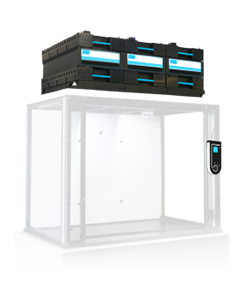
The ceiling-mounted Halo filtration system was originally designed to protect laboratory personnel from laboratory pollution exposure. The design was based on a very delicate equation of the right airflow, depth of carbon bed, and air distribution.
This unique approach was developed through over 50 years’ experience in providing air filtering solutions to laboratories across the globe. Our flexible and adaptable designs give us the ability to integrate HEPA H14 or ULPA U17 filters to the Halo. This has allowed us to adapt to the necessary demands of HEPA-filtered air purifiers, even outside of the laboratory. Because of the strict standards we have had to adhere to within the lab world, the Halo was designed with more than just filtration in mind. It also takes into consideration the impact the Halo would have on the facility’s ventilation effectiveness (VEFF) and increases in air change rate (ACH).
The Halo’s proven efficiency in a lab setting is transferable to the commercial world and has provided us the ability to ensure we meet all necessary criteria, such as:
- Air flow pattern distribution
- Increased ACH
- Optimal H14 HEPA filtration
Each Halo will provide 3 additional ACH per every 3,500 Cu’ of volume. The placement of the Halo is critical to achieving such phenomenal results. Its position on the ceiling creates a vertical air flow pattern that drives polluted air up and away from the breathing zone and returns clean air back into the very same room horizontally across the ceiling. This creates what is known as the Coanda effect:

- Air flow pattern distribution
- Increased ACH
- Optimal H14 HEPA filtration
Data derived from a number of different thirdparty tests proves Halo’s performance against aerosolized viruses and PM 2.5. Tests were conducted in both controlled spaces and in real-world conditions to truly understand the efficacy of the Halo’s performance.
With other virus mitigation options, there are serious risks to consider. Simply put, there is a lot of snake oil available on the market. Everywhere you look, someone seems to have the best possible solution. They promise
99.99% decontamination or effectiveness. The reality is there are many unethical companies that are taking advantage of the current anxiety-ridden air purification market. At Erlab, our data is unmatched, third-party certified, and not full of “fluff” data. We provide the truth and set the expectations according to the product’s actual performance in a realworld setting. There is simply no false data or misleading performance criteria. The Halo will perform as advertised and will mitigate the risk of airborne spread, while also improving your IAQ. This is a long-term solution; the Halo is a permanent infrastructure improvement without the infrastructure cost or complexities.
This is a solution for today’s challenges and tomorrow’s well-being.
The Long-Term Playbook
What should a business do in order to improve air quality and minimize the risk of viral transmission? It starts with understanding your current ventilation. You should seek to answer these key questions:
- What will it cost to increase my air change rates per hour, what impact will this have on my current heating and cooling loads?
- Can my system, as currently designed, handle an upgrade in filters?
- If we increase our air change rates and upgrade our filters, how are we going to control possible re-entrainment concerns?

In most cases, there should be a supplemental solution to tie in with your existing ventilation system. The most effective supplemental technology would be air filtration with HEPA rated filters, positioned above the breathing zone (ceiling mounted) to ensure proper airflow patterns, and increased ventilation effectiveness with proper room mixing. The size of each room will need to be taken into consideration as it will determine the effectiveness of air purifiers. Whichever direction you decide is best for your facility’s unique situation, the decision should be a permanent one backed by data.
Halo Smart Air Purification Stations
Efficacy of the Halo HEPA system against aerosolized viruses:
The Halo was tested within a controlled Biosafety Level chamber under challenge conditions where MS2 bacteriophage was purged into the chamber and held for 90 minutes in order to obtain total log reduction results over time. As seen in the below graph, log reductions were achieved within 15 minutes, with a continuous decrease throughout the 90 minute challenge test, which equates to a 99.99% reduction in viable MS2.


Real-world performance results
In order to further validate the Halo’s efficiency at mitigating the risk of airborne viral transmission, we tested the Halo within an isolation room of a confirmed COVID 19 positive patient against an adjacent isolation room of a confirmed COVID 19 patient of which both shared the same air handling system. Each room was swabbed at the floor, window surface and at the return registers for SARS-CoV-2 using the gold standard of a polymerase chain reaction (PCR) test. The results as (seen below) provide us with some key pieces of information, such as; Viral shedding of each patient and reduction of present SRA-CoV-2 RNA. Based on these results it is clear the patient in room 120 (with the Halo) had significant viral shedding as they were at the beginning of isolation, whereas the patient in room 118 (without HALO) viral shedding was minimal as they were at the end of isolation. However, even with the significant amount of shedding from the patient in room 120, there was still no detectable RNA found at the return register, or within the airstream further solidifying the performance of the Halo at mitigating airborne viral loads and concentrations. Antithetical to these results are the results in room 118, where SARS-CoV-02 RNA was present at the return register and within the airstream even without detectable RNA present anywhere else within the room.


Conclusion
As we deal with a viral pandemic, we also have to be sure to address the unfortunate reality of poor air quality. We can take immediate positive action concerning the air we breathe indoors with the proper technologies and mitigation strategies in place.
