




INTRODUCTION
Analytical testing laboratories and research facilities in the agriculture industry rely on state-of-the-art equipment to perform complex analysis and chemical applications. From terpene profiling to contaminate testing for pesticides, residual solvents, heavy metals, and mycotoxins/ aflatoxins, an analytical testing laboratory requires specific engineering control devices to operate efficiently and to provide a safe environment for the staff.
Air renewal systems, safety workstations, clean air enclosures, and storage solutions play an important part of your laboratory safety program and must be selected with care. Air filtration systems capture chemical, biological, and particulate pollution at the source, and are an effective solution in mitigating chemical exposure, and other safety hazards in a room.
Find out more about Erlab solutions and overcome your challenges when setting-up your new laboratory or upgrading your existing operations.

“Erlab equipment plays an important role in safety.”
Application Area:
Soil and Plant analysis, evaporation of organic solvents
“This equipment is used during concentration of sample solutions by evaporation of organic solvents. It is also used during extraction of soil and plant samples. This equipment removes all fumes developed during the extraction process with the help of its fan and appropriate filter.”
SAFETY WORKSTATIONS FOR YOUR PLANT SAMPLING AND ANALYSIS
HOW IT WORKS
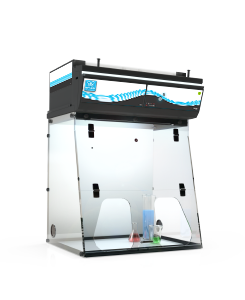
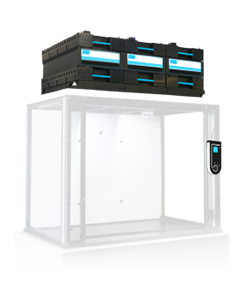
The Smart hoods are used to safely perform solvent-based extraction methods, and sample preparation applications which often contain formic acid or other harmful acids.
These Containment Ventilated Enclosures (CVEs) are also recommended to place your moisture analyzer (loss on drying system), as they will capture the terpenes volatilized during the process at the source.
You can also perform the residual-solvent testings in these enclosures to prevent the propagation of volatile solvents back in the laboratory space.
Microwave digestion is another common application carried-out in the Smart hoods to protect the laboratory staff from noxious vapors of nitric acid.
More instruments can be placed in the Smart hoods to avoid any release of contaminants, such as VOCs, acid vapors, particulates, in the ambient air (rotary evaporators, analytical balances, microbalances, mixing plate, vortex, homogenizers).

MODELS
- 392 Smart (3-ft model)
- 483 Smart (4-ft model)
- 714 Smart (6-ft model)
ACCESSORIES
- Fixed bench (for all models)
- Mobile bench (only for 392 Smart)
- Particulate filtration with HEPA H14 filters
- 822 Smart under bench filtered storage cabinets for solvents & acids (one unit for 392 & 483 Smart; up to two units for 714 Smart)
BENEFITS
- Advanced laboratory-grade filtration technology
- Powered by Smart Technology, a simple and intuitive communication by light. Real-time monitoring of the performance of the fume hood (chemical breakthrough sensor, airflow sensor)
- Quick and simple installation
- No connection to ductwork required. Dramatically reduced construction and equipment costs as no ductwork installation or HVAC upgrade is required (lower infrastructure costs upfront and lower energy costs over time)
- Energy efficient – uses 65W of electrical power – equals typical incandescent light bulb
- Environmentally sustainable as no contaminants are being released in the atmosphere
AIR PURIFICATION STATIONS
HOW THEY WORK
Air renewal is a fundamental requirement for maintaining hygiene, safe conditions and sample test repeatability in an analytical testing laboratory.
The Halo Smart air purification stations capture chemical emissions and noxious odors at the source and permanently lock them in an ultra-high-efficiency activated carbon filter, returning clean air to the laboratory space, with no HVAC connection.

These air purification stations are effective in the heavy metal analysis room, as the harmful gases tend to accumulate in the ambient air. Upon transferring samples from a microwave digestor to a fume hood for further dilution, releases of chemical vapors will most likely occur and contaminate the laboratory space. The Halo Smart will actively purify the said area, adsorb the chemical vapors, and clean the heavy metal room’s ambient air.
In the general laboratory spaces, methanol, acetonitrile and other organic solvents are frequently used for plant extraction, and have been known to quickly accumulate in the air. For other rooms such as those with GCMS for the analysis of terpenes, solvents, and pesticides, the GCMS often releases chemical vapors through the split-vent trap and the vacuum pump into the laboratory space. While monitoring these contaminants as per state regulations, they can eventually appear as background in the GC systems. The Halo Smart will directly address these issues and continuously remove contaminants and VOCs from the ambient air, not only protecting the staff but also keeping pollutants from the analytical systems present.
Other areas can benefit from the Halo Smart, such as chemical storage rooms, to capture harmful vapors and lingering odors. You can also consider them for adjacent office spaces, which can be contaminated with chemical and terpenes smells, exposing the staff to unnecessary pollutants.
Installing a Halo Smart in the laboratory guarantees a high level of air quality without having to resort to cumbersome air renewal systems or connections to HVAC which can redistribute chemical or biological atmospheric pollutants throughout a building.

MODELS
- Halo Smart VOCs (suitable for VOCs, solvents)
- Halo Smart Chemplus S (suitable for VOCs, solvents and acids)
- Halo Smart P – also exists with particulate filtration
BENEFITS
- Advanced laboratory-grade filtration technology
- Detection and filtration of the main categories of pollutants (VOCS, acids)
- Standalone system, totally independent of the HVAC system. No HVAC upgrades needed, means less concern of proper room balance and control of RH levels, and less upfront and operational cost
- Contributes to controlled direction air flow patterns
- Runs 24/7. No accidental shut off. Continuous air quality improvement
MICROBIAL TESTING WITH A PCR WORKSTATION
HOW THEY WORK
When performing microbial screening, strict considerations must be taken to maintain a sterile environment and avoid cross-contamination. The qPCR analysis will require a clean workspace to protect your samples and avoid any contamination risks.
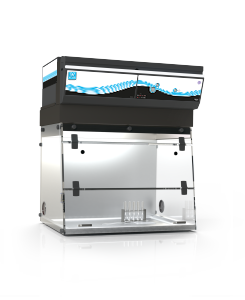
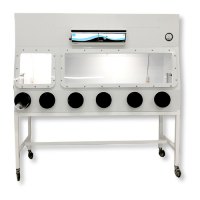
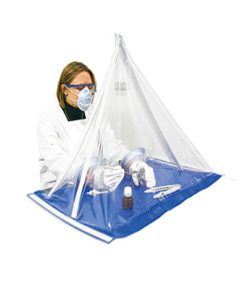
Frequently installed in the microbiological testing room, PCR workstations are HEPA-filtered enclosures designed to perform sensitive qPCR preparations, while protecting against both environmental pollution and cross-contamination.
It features a built-in ventilation system and a laboratory-grade HEPA H14 filter to dramatically reduce contamination risks from the laboratory’s ambient air that may contain pathogens from other contaminated samples present in the room (i.e. aspergillus). These PCR workstations also feature high energy UV lights to decontaminate the worktop from biological cross-contamination between two operations.

MODELS
- Bio 391 Smart (39-inch enclosure + dynamic enclosure)
- Bio 321 Smart (32-inch enclosure + dynamic enclosure)
- Bio 320 Smart (32-inch enclosure + static enclosure*)
*No ventilation module and HEPA filter, UV light only
BENEFITS
- Particle free workstation
- Powerful UV decontamination (featuring 2 lamps of 254 nm each)
- Powered by Smart Technology, a simple and intuitive communication by light.
- Real-time monitoring of the performance of the workstation
- Quick and simple installation
- Ergonomic design with UV resistant front and side panels
- Very low energy consumption
SAFE STORAGE CABINETS FOR CHEMICALS AND WORKING SOLUTIONS
HOW THEY WORK
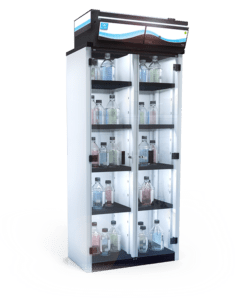
The Smart filtering storage cabinets are designed to safely keep all solid and liquid chemicals from your laboratory (incl. solvents, acids, bases and powders). These models are also suitable to store working solutions frequently used in the analysis of agricultural crops, including mobile phase mixtures for the HPLC, acidified acetonitrile for pesticides extraction, laboratory quality control mixtures, and other solvents for extraction applications.
These filterering storage cabinets will also be an added safety solution in the microbial laboratory space to safely keep chloroform solutions often employed in DNA extractions for PCR analysis.
Also suitable to capture terpenes odors when storing samples inside the cabinet (avoid unnecessary, lingering, nuisance odors in your laboratory or nearby office spaces).

MODELS
- 822 Smart (small model), two versions
- 834 Smart (large floor standing model)
- 1634 Smart (extra-large floor standing model)
BENEFITS
- Advanced laboratory-grade filtration technology tailored to the storage of powders and liquids
- Powered by Smart Technology, a simple and intuitive communication by light. Real-time monitoring of the performance of the storage cabinets (chemical breakthrough sensor, airflow sensor, door sensor)
- Quick and simple installation
- Clear doors for easy viewing and quick access to your bottles
- Secure, lockable storage
- High corrosion resistance
- No connection to ductwork required.
- Energy efficient – uses 35W to 45W of electrical power – equals typical incandescent light bulb.
- Environmentally sustainable as no contaminants are being released in the atmosphere.
FILTRATION SYSTEM FOR YOUR EXISTING STORAGE CABINET
HOW THEY WORK
Hexane, methanol, acetonitrile, formic acid, nitric acid, ormic acid, and hydrochloric acid are the most commonly stored materials in analytical laboratories. They will be often kept in flammable or corrosive chemical storage cabinets without appropriate ventilation system connected to it. In this situation, significant concentration of chemical vapors will accumulate inside the storage cabinets, exposing the technician to unwanted chemicals and safety hazards when doors are opened.
Accidental spills inside the cabinet may also occur, representing another serious risk for the laboratory personnel that you need to address.
The ChemTrap is a filtering device designed to be integrated onto a flammable or corrosive chemical storage cabinet, resulting in the additional benefit of protection against hazardous emission inhalation. Designed as a standalone system with no need for ducting, it is equipped with an adjustable pipe that accommodates connection points from the side or the back of your existing cabinet.

MODELS
- ChemTrap Solvents
- ChemTrap Acids
BENEFITS
- Advanced laboratory-grade filtration technology tailored to the storage of powders and liquids
- Turns your safety cabinet into a standalone filtration unit
- No release of hazardous emissions when doors are opened
- Elimination of noxious vapors through filtration
- Requires no connection to HVAC system
- Helps to renew and purify laboratory air
- Compatible with the majority of safety cabinets
- Quick and simple installation
- Easily connects to existing threaded bung
