



Every November, facilities managers start watching utility bills climb. By January, they’re explaining to finance why the heating budget is hemorrhaging. Lab managers see the same numbers and wonder why leadership keeps questioning their equipment purchases.
The answer is running 24/7 in your lab, exhausting thousands of cubic feet of heated air straight through the roof.
Traditional ducted fume hoods don’t just protect your people from chemical vapors. They also function as extremely expensive exhaust fans that throw away the warm air your HVAC system just spent money creating. In winter, this waste intensifies. You’re not just exhausting air – you’re exhausting air you paid to heat.
Let’s look at where that money actually goes, what it costs you across a cold season, and what you can do about it without compromising safety.
How Ducted Hoods Turn Warm Air Into Wasted Money
A ducted fume hood works by pulling air away from the operator and venting it outside the building. The faster the exhaust, the better the protection. That’s the safety equation, and it’s non-negotiable.
But here’s what that safety mechanism does to your energy budget:
A standard 6-foot ducted hood exhausts between 700 and 1,000 cubic feet per minute (CFM) depending on sash position and face velocity settings. That air is conditioned – meaning your HVAC system heated it to 70°F, filtered it, humidity-controlled it, and delivered it to the lab. The hood then immediately pulls that conditioned air through its working volume and exhausts it to the roof.
Gone. Permanently.
Your building now needs to replace that exhausted air with fresh outdoor air. In winter, that replacement air arrives at your building at 20°F, 10°F, or colder depending on your climate. Your HVAC system must heat that incoming air from outdoor temperature to room temperature just to maintain thermal comfort. This is called make-up air, and it’s where your money disappears.
The process repeats continuously. Every minute, 700-1,000 cubic feet of warm air leaves. Every minute, 700-1,000 cubic feet of cold air enters and requires heating. A single ducted fume hood can exhaust the heated air volume of an entire laboratory multiple times per hour.
The Math That Makes Facilities Directors Wince
Let’s work through the actual numbers so you can apply them to your facility. The figures below are for illustrative purposes to show you the calculation framework – your actual costs will vary based on your location, energy rates, HVAC efficiency, and specific applications.
Energy cost for ducted fume hood operation is typically calculated per CFM per year. Documented ranges from peer-reviewed studies and university sustainability programs show costs between $3.70 and $7.40 per CFM annually. This range accounts for different climates, energy rates, and HVAC efficiency.
Harvard’s Office for Sustainability documented their energy cost at $7.43 per CFM per year – among the highest in published data, reflecting New England energy rates and cold winters. Other institutions in milder climates report costs closer to $3.70 per CFM per year.
Take a 6-foot hood exhausting 800 CFM as a working example:
Annual operating cost = 800 CFM × $5.50/CFM/year = $4,400/year
That’s using a middle-range figure of $5.50 per CFM per year. If you’re in a cold climate with expensive energy, your number trends toward the high end ($5,900/year). Milder climate with cheaper natural gas brings you toward the low end ($2,960/year).
Now consider you probably don’t have one hood. You have five, ten, maybe twenty. A lab with ten ducted hoods at the middle cost estimate burns through $44,000 annually just to operate the ventilation.
These figures come from multiple sources including Lawrence Berkeley National Laboratory, the American Chemical Society’s Chemical Health & Safety journal, and sustainability offices at major research universities. They’re not theoretical. They’re measured, documented, and consistently reported across institutions.
Winter Is When The Bleeding Gets Worse
Those annual averages hide seasonal variation. Winter amplifies the cost because the temperature differential between outdoor air and conditioned air is largest.
Imagine your HVAC system on a December morning. Outdoor temperature is 15°F. Your lab needs to maintain 70°F. That’s a 55-degree temperature lift for every cubic foot of make-up air.
Now imagine the same system in April when outdoor temperature is 55°F. The temperature lift drops to 15 degrees. Your HVAC works a third as hard to condition the incoming air.
The energy required to heat air scales with temperature differential. Larger differential means more fuel burned. December through February, when temperature differentials are largest, your fume hood operating costs peak.
Some institutions report 40-50% higher utility costs during winter months compared to shoulder seasons, with fume hood exhaust being the largest single driver of that increase. Your hoods run continuously through the coldest part of the year, exhausting expensive warm air and forcing your heating system to run harder, longer, and more often.
Labs in cold climates feel this most acutely. A facility in Minneapolis or Boston pays far more per CFM during January than a facility in Phoenix. But even warm-climate facilities see winter spikes – Phoenix still drops to the 40s at night, and that outdoor air still requires heating.
The 3.5 Homes Comparison Everyone Remembers
Multiple universities use the same analogy in their sustainability campaigns: a single open fume hood consumes energy equivalent to approximately 3.5 homes.
This comparison appears in “Shut the Sash” programs at institutions including the University of Virginia, University of Chicago, and others running formal hood management initiatives. It’s memorable because it’s startling, and it’s accurate enough to communicate scale.
The average U.S. household uses about 10,500 kWh of electricity annually. A ducted fume hood running continuously can consume or require conditioning energy in that same range when you account for fan power, exhaust CFM, and make-up air heating/cooling loads.
This is the number that makes leadership pay attention during budget reviews. When you tell the CFO that your lab’s ventilation system uses the same energy as a small neighborhood, suddenly those equipment upgrade requests get a different kind of scrutiny.
But here’s the part that matters: this energy use is often unavoidable with ducted systems. You can’t turn off fume hoods when they’re protecting people from perchloric acid, hot acid digestions, or unknown chemistry. Safety requires exhaust. Exhaust requires make-up air. Make-up air requires conditioning. The cost is locked in by the hazard profile.
Where Recirculating Technology Changes The Equation
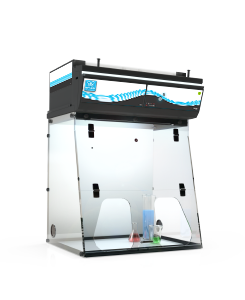
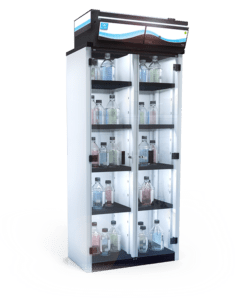
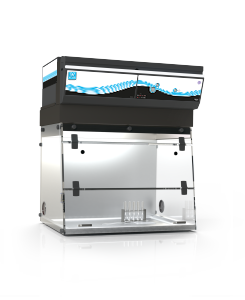
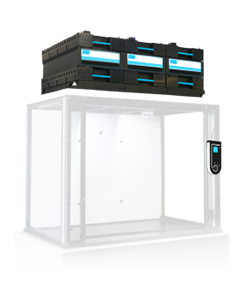
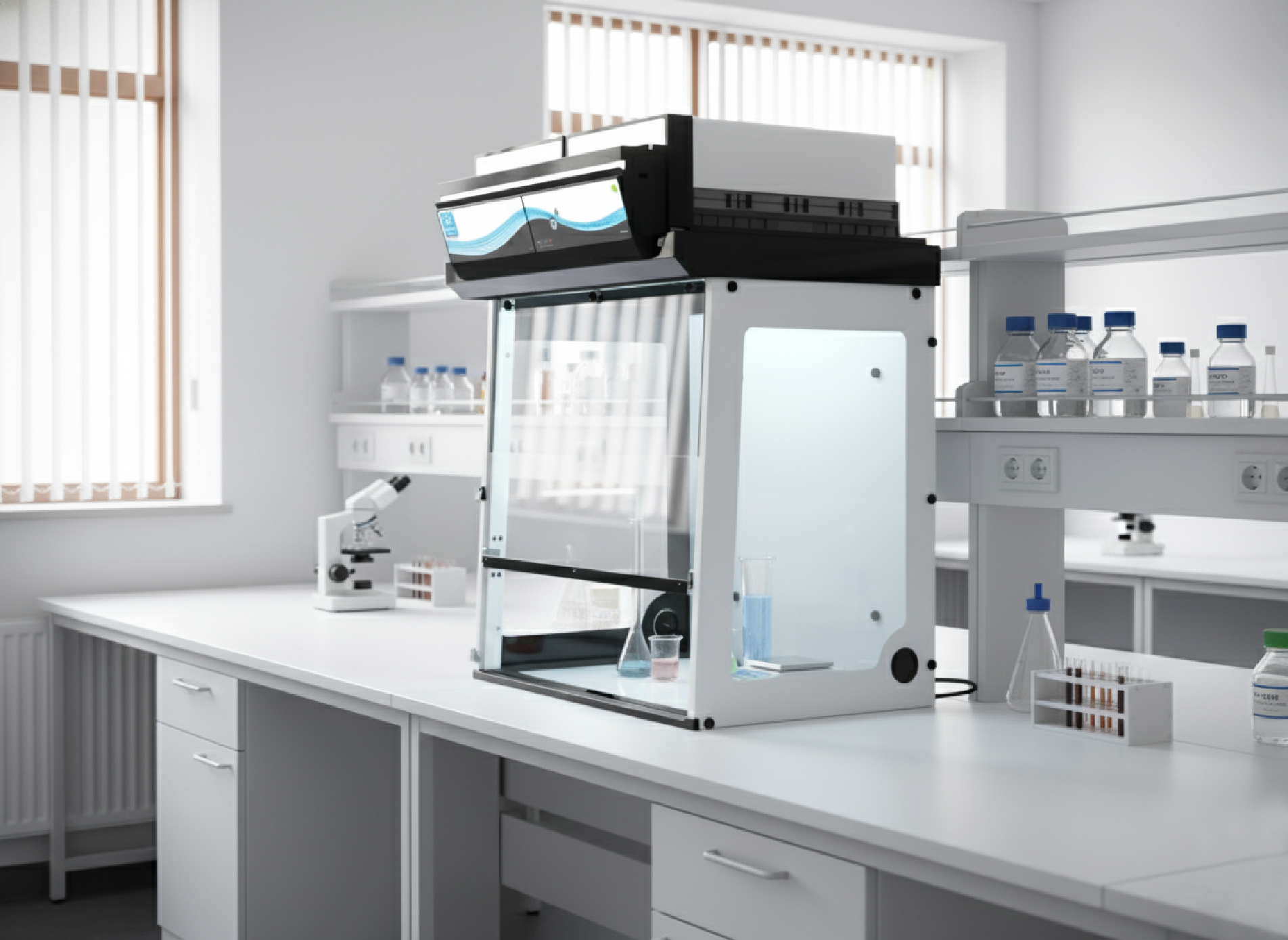
Ductless fume hoods take a different approach. Instead of exhausting air to the outdoors, they filter it and return it to the lab.
The safety mechanism shifts from “remove contaminated air from the building” to “remove contaminants from the air.” Molecular filtration captures vapors and gases through activated carbon adsorption. Particulate filtration captures powders and aerosols through HEPA filtration. The cleaned air recirculates into the lab.
This eliminates the exhaust. No exhaust means no make-up air requirement. No make-up air means no heating (or cooling) of outdoor air. The HVAC system maintains the existing lab environment rather than continuously conditioning fresh outdoor air.
From an energy perspective, the difference is substantial. A ductless hood uses only the fan power required to move air through its filters – typically 200-400 watts. Compare that to the thousands of watts required to heat make-up air for a ducted hood in winter, plus the fan power for the exhaust system itself.
The energy savings can reach 95% compared to ducted hoods, though actual savings depend on climate, energy rates, and HVAC system efficiency.
But here’s what matters most to lab and facilities managers: this isn’t a compromise on safety. It’s a different safety mechanism with different appropriate applications.
Running The Numbers For Your Facility
Let’s work through a realistic scenario for a pharmaceutical QC lab with moderate climate conditions. Remember: these are illustrative figures to demonstrate the calculation method. Your actual costs will depend on your energy rates, climate, chemistry profile, and specific filtration requirements.
Current state
- 8 ducted fume hoods
- Average 750 CFM per hood
- Operating cost of $5.00 per CFM per year (mid-range estimate)
- Annual operating cost of 8 hoods × 750 CFM × $5.00/CFM/year = $30,000/year
After replacing 4 hoods with ductless for appropriate applications (powder weighing, formalin dispensing, small-volume QC testing)
- 4 ducted hoods remain for varied chemistry work
- 4 ductless hoods for known, limited chemistry
- Ducted hood operating cost of 4 hoods × 750 CFM × $5.00/CFM/year = $15,000/year
- Ductless hood operating cost is minimal (fan power only, approximately $100/year per hood = $400/year)
- Filter replacement of 4 hoods × 2 filters/year × $900/filter = $7,200/year
New annual total of $15,000 + $400 + $7,200 = $22,600/year
Annual savings of $30,000 – $22,600 = $7,400/year
Over a 10-year equipment lifecycle, that’s $74,000 in operating cost reduction. This doesn’t account for avoided installation costs (no ductwork or roof penetrations for the ductless units) or the ability to relocate ductless units as lab layouts change.
The payback period for ductless hood investment typically falls between 18 and 36 months when energy savings and avoided installation costs are factored together.
Your specific numbers will vary based on these factors.
- Local energy rates (natural gas, electricity)
- Climate (degree days of heating/cooling)
- Current HVAC system efficiency
- Number of hoods and average CFM
- Filter replacement frequency for ductless units
- Specific chemistry profile and appropriate applications
But the framework remains consistent: identify applications where chemistry is known and limited, calculate current operating costs, compare against ductless TCO including filters, and evaluate payback period.
How Facilities And Labs Actually Work Together On This
The biggest obstacle isn’t technology or cost. It’s coordination.
Lab managers know which hoods handle repetitive, known chemistry. Facilities managers know energy costs and HVAC capacity. EHS teams approve containment devices. Procurement executes purchases. All four groups need to be in the same conversation, but they rarely are.
Here’s what successful implementations look like.
Start with a hood inventory. Not just a count, but a detailed assessment of what each hood actually does. Which hoods handle varied chemistry where ducted exhaust is non-negotiable? Which hoods handle powder weighing, formalin dispensing, or teaching demos where chemistry is predictable?
Calculate current operating costs. Facilities should provide energy rates and HVAC operating parameters. Use the $3.70-$7.40 per CFM per year range as a starting point, then adjust for local conditions. Document total annual operating costs for all hoods.
Identify replacement candidates. Look for hoods handling known chemistry in modest volumes. Powder weighing stations are obvious candidates – they need containment but not exhaust. Histology benches using formalin and xylene fit the profile. QC labs running repetitive tests with the same solvents every time make sense.
Build the business case together. Facilities provides energy cost data. Labs provide chemistry profiles. Procurement prices both ducted and ductless options. EHS reviews appropriateness. The business case includes energy savings, filter costs, avoided installation costs (if replacing aging ducted hoods), and payback period.
Don’t try to replace everything. Ductless works for specific applications. Keep ducted hoods for perchloric acid, hot acids, and varied chemistry. Deploy ductless for appropriate use cases. A mixed approach typically delivers the best combination of safety and cost management.
Plan around capital cycles. Don’t force a replacement schedule. When a ducted hood reaches end-of-life or a lab renovation creates opportunity, evaluate whether ductless fits that specific application. Incremental replacement over 5-7 years as equipment naturally cycles reduces budget impact and allows learning from early installations.
The conversation works best when it’s framed as “where can we use different technology appropriately” rather than “how can we save money.” Safety remains the primary concern. Energy cost reduction is the outcome when appropriate technology is properly matched to the application.
Budget Cycles And Incentive Programs You Can Actually Use
Most organizations can’t cut a check for new equipment outside their capital planning cycle. That’s fine. This is a multi-year opportunity.
Capital budget timing. Many institutions finalize capital budgets in Q2 for the following fiscal year. That means you need to build your business case between January and March for equipment purchases 6-12 months out. Start inventorying hoods now. Document chemistry profiles and operating costs through winter when energy costs are highest. Present the business case with actual utility bills showing seasonal variation.
Utility incentive programs. Some utility companies offer rebates for energy efficiency improvements in commercial facilities. These programs vary significantly by region and utility provider, but they’re worth investigating. Contact your utility account representative and ask specifically about HVAC load reduction incentives. Some programs will subsidize equipment that reduces heating/cooling loads.
Sustainability grant programs. Universities and some corporate facilities have internal sustainability grant programs funded separately from capital budgets. These grants specifically target energy reduction projects. If your organization has a sustainability office or corporate responsibility program, they may have funding mechanisms outside normal budget channels.
Deferred payment and financing. Equipment manufacturers (including Erlab) often offer financing that spreads payments across multiple budget years. This can make a purchase possible when capital budget is limited but operating budget has room. The energy savings can offset the financing costs, creating a cash-flow-neutral improvement.
Pilot programs. If selling a major conversion is difficult, propose a pilot. Replace one or two hoods in appropriate applications. Document energy savings over 6-12 months with actual utility data. Use that documented performance to justify larger-scale deployment. Pilots reduce risk and provide real-world data for your specific facility.
The key is aligning your timeline with budget reality. You probably can’t replace five hoods this quarter. But you might replace one hood this year, two next year, and three the year after as capital budget allows and older ducted hoods reach end-of-life.
What This Looks Like In February
February is when the pain peaks. Outdoor temperatures bottom out. Heating systems run continuously. Utility bills arrive with numbers that make controllers ask questions.
This is also when lab managers and facilities managers have the most productive conversations, because the problem is visible in real-time.
As an example: a ducted fume hood exhausting 800 CFM in February might consume roughly 50-60 therms of natural gas per month for make-up air heating (depending on HVAC efficiency and outdoor temperature). At typical natural gas rates, that could be $75-$90 per hood per month just for heating fuel. Multiply by the number of hoods in your facility. Add the electricity for fans. That gives you a sense of your winter ventilation bill’s scale. Your actual costs will depend on your energy rates and climate.
Ductless hoods eliminate that exhaust. The fan still runs (using minimal electricity – typically comparable to running a few light bulbs). Filters need periodic replacement (budgeted annually, not fluctuating with weather). But the make-up air heating cost disappears entirely.
For labs in cold climates, this is the difference between budgets that work and budgets that don’t. For labs in any climate, it’s an opportunity to redirect operating budget from utility bills toward equipment, staffing, or research.
The Honest Limitations You Need To Know
Ductless filtration is not a universal solution, and anyone who tells you otherwise is either ignorant or dishonest.
Filters have capacity limits. They saturate over time. They require monitoring for breakthrough. They need periodic replacement. That’s not a flaw – it’s how filtration technology works. The key is matching filter capacity to chemical usage and implementing monitoring protocols that catch saturation before it becomes a safety issue.
Many institutions restrict ductless hood usage or require case-by-case EHS approval. Universities including Ohio State, VCU, and UNC have published policies ranging from “prohibited in labs” to “approval required for exceptional cases.” This isn’t because ductless hoods are unsafe. It’s because they require more careful application-specific evaluation than ducted hoods.
If your institution has restrictive policies, focus on applications where approval is most likely: powder weighing stations with HEPA filtration, teaching demonstrations with known chemicals, and specific repetitive processes like formalin dispensing. Build documentation showing appropriate use, proper monitoring, and safety equivalence.
The total cost of ownership includes filter replacement. Filter costs vary significantly depending on your specific chemistry, filtration requirements, and usage patterns – anywhere from a few hundred to several thousand dollars per filter. Replacement frequency also varies from 6 months to 24 months based on chemical load and monitoring data. These costs are predictable and budgetable, and in most appropriate applications, they’re still less than the energy cost of exhausting conditioned air continuously.
The value proposition works when chemistry fits filtration capabilities. When chemistry doesn’t fit, use ducted hoods. This is about deploying the right technology for the right application, not about replacing every hood in your facility.
What To Do Next
If you manage a lab or facility with fume hoods and you’re reading this in the middle of winter while heating bills climb, here’s where to start.
Count your hoods and document what they do. Not “we have 12 hoods.” Rather, document specifics like “Hood 1 handles perchloric digestions, Hood 2 is for powder weighing, Hood 3 does formalin dispensing, Hood 4 handles varied organic chemistry…” Know what each hood actually does.
Calculate current operating costs. Work with facilities to get energy rates and HVAC operating data. Use the $3.70-$7.40 per CFM per year range and adjust for your climate. Get a real number for what you’re spending annually. Compare that number to the latest utility bill to see the seasonal variation.
Identify the obvious candidates. Look for hoods handling known chemistry in limited volumes. Powder weighing. Teaching demos. Repetitive QC testing. Formalin work. These applications have predictable chemistry profiles that match filtration capabilities.
Talk to your EHS team. Before you price equipment or build a business case, find out what your institution’s position is on ductless hoods. If they have restrictive policies, understand why and what documentation would support an exception.
Build a realistic timeline. You probably can’t replace multiple hoods this quarter. But you might pilot one ductless hood in an appropriate application, document its performance through the rest of winter and into summer, and use that data to justify broader deployment in the next budget cycle.
The conversation isn’t “should we switch to ductless hoods.” The conversation is “where can we appropriately use recirculating technology to reduce operating costs without compromising safety.”
Winter is when the cost of exhausting warm air becomes impossible to ignore. That makes it the right time to evaluate whether some of your ventilation load can be handled differently.
Your heated air is going somewhere. The question is whether you’re okay with where it’s going and what it’s costing you to send it there.
