


HALO HOSPITAL AIR PURIFIER IS BUILT FOR ROOMS & HALLWAYS PATIENTS AND STAFF SHARE
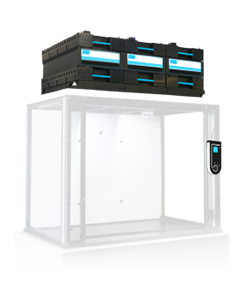
Lab-grade HEPA filtration mounted overhead, pulling airborne particles and viruses up and away from waiting rooms, exam rooms, and the public spaces between.
The air in a hospital or clinic carries what everyone brought with them. Standard ventilation just moves it around. HALO is an air purifier for hospital and clinic spaces – ceiling-mounted HEPA filtration built on more than 50 years of Erlab laboratory work.


99.995% HEPA H14 filtration

99.99% viral reduction, independently tested

Biosafety-cabinet-grade filters

ASHRAE 241 certified

50W, runs around the clock

Overhead, out of the way
Get a quote within 1 business day.
Tell us about your facility and an engineer will get back to you with all the info you need.
How the HALO hospital air purifier works
HALO embeds in the ceiling or hangs from it, and connects to building power overhead. No ductwork, no HVAC changes, installed in hours, room by room if you need it that way.

Air is drawn up.
Room air is pulled up into the unit, lifting aerosols and fine particles away from the seated, waiting, and resting people below.

Lab-grade filtration.
Air passes through HEPA H14, the same filter grade used in biosafety cabinets that contain live pathogens, or carbon for odors where that is the concern.

Clean air returns at the ceiling.
Filtered air rides the ceiling outward and settles back slowly, keeping the whole room turning over instead of pushing air across it at head height.
A Smart-Light ring shows status at a glance, and the eGuard app gives your facilities and infection-control teams remote monitoring, alerts, and filter detection. Nothing for clinical staff to manage.

The air filters hospitals already trust, mounted overhead
The HEPA H14 in a HALO is the same class of hospital air filter used in biosafety cabinets to contain dangerous pathogens. It captures 99.995% of particles at the most penetrating size, which covers the fine aerosols that carry respiratory viruses, along with bacteria, mold, and allergens.
Where odors are the issue rather than particles, the carbon version handles VOCs from cleaning products, sterilization, and treatments. Hospital air filters are only as good as how consistently they run, which is the other half of the point. HALO is fixed overhead and runs around the clock, so the filtration is always on rather than depending on someone leaving a unit switched on.
The proof, in a lab and in a working clinic

99.99% viral reduction.
In independent ARE Labs testing, HALO cut aerosolized MS2 virus, a surrogate for influenza and SARS-CoV-2, by 99.99% within 90 minutes in a sealed bioaerosol chamber.
34 to 55% fewer particles.
In a working dialysis center, a single HALO filtering the room about 11 times an hour cut fine particles by 34 to 55% depending on the scenario, measured with a calibrated particle counter.
Certified to ASHRAE 241.
HALO is independently tested and certified to meet the highest standard for controlling infectious aerosols in occupied buildings.
Where HALO fits in a hospital or clinic

Waiting and reception areas
The room where sick and well people sit closest together, often the longest. Continuous overhead filtration cuts the shared airborne load.

Exam and treatment rooms
Rapid turnover all day. HALO keeps the room air cleaner between patients without anything for staff to switch on.

Infusion and dialysis bays
Patients seated for hours, often immunocompromised. A clinic air purifier overhead works the whole time they are there.

Recovery and observation
Where patients rest and breathe for extended stretches in shared space.

Staff areas and nurse stations
The people who are there every shift, breathing the building all day, not just for one appointment.

Labs and pharmacy
HEPA for particles, carbon for the chemical and compounding odors that build up in the room.
How many units does your space need?
Coverage comes down to room volume and the air change rate you want from HALO. Each HALO HEPA unit moves about 10,590 cu ft of air per hour. Enter a room below for a quick estimate.
Exam room
Treatment or dialysis bay
Waiting room
Large waiting area or lobby
Room volume
4,500 cu ft
Filtered air needed
18,000 cu ft/h
HALO HEPA units
2 units
Example estimates, at the listed ceiling heights:
| Clinical space | Size | Volume | Target ACH (from HALO) | HALO HEPA units |
|---|---|---|---|---|
| Exam room (9 ft ceiling) | 120 sq ft | 1,080 cu ft | 6 | 1 units |
| Treatment or dialysis bay (9 ft ceiling) | 300 sq ft | 2,700 cu ft | 6 | 2 units |
| Waiting room (9 ft ceiling) | 500 sq ft | 4,500 cu ft | 4 | 2 units |
| Large waiting area or lobby (10 ft ceiling) | 1,200sq ft | 12,000 cu ft | 4 | 5 units |
A planning estimate for the filtered air HALO adds, on top of your facility’s ventilation. Layout, ceiling height, and occupancy all affect placement, and every order includes a coverage consultation that scopes the real number.
Real-time tracking of your facility
Infection-control committees, facilities leadership, and patients all want to see evidence. Erlab AirGradient monitors track particulate, VOCs, CO2, temperature, and humidity in real time, so the improvement shows up as data.

Step 1
Assess
Place AirGradient monitors in the rooms that matter most and see what the air is doing through a working day.

Step 2
Address
Put HALO units where the data and the patient flow point, ceiling-mounted and always on.

Step 3
Assure
The Indoorcare dashboard tracks it over time, giving infection control and leadership a record rather than a claim.
What HALO costs to run
| Cost component | HALO hospital air purifier |
|---|---|
 Electricity
|
50W per unit, about $52.60 a year each at $0.12 per kWh, running around the clock. |
|
Filters
|
Folded into a roughly $0.48 a day all-in operating estimate per unit, with automatic filter detection so nothing gets missed. |
 Install
|
Hangs from the ceiling and connects to power overhead. No ductwork, no construction, room by room if needed, hours rather than weeks. |
 Disruption
|
Installs without opening up the building or interrupting a department for long. |
The roughly $0.48 a day figure is an illustrative example covering electricity and amortized filters, based on published Erlab data. Real filter intervals shift with the space and how busy it is.
The questions your team will raise
| The concern | The reality | How we help |
|---|---|---|
| We already have hospital-grade HVAC. | HVAC dilutes and exchanges air over time. It wasn’t built to pull fine particles and viruses out of the room at the moment patients are sitting in it. HALO adds that filtration right where people are. | A walkthrough and AirGradient data show what your ventilation is and is not clearing in specific rooms. |
| We have some portable units already. | Floor units push air sideways at seated height, which can move one patient's exhaled air toward the next. HALO pulls air up and away from people instead. | We map where overhead filtration covers a room more evenly than scattered floor units. |
| Will installing it disrupt the department? | HALO mounts to the ceiling and connects to power overhead, with no ductwork or construction, so it goes in room by room in hours. | We schedule around your clinical hours and confirm placement before anything is ordered. |
| How do we know it works? | Independent lab testing shows 99.99% viral reduction, a working dialysis center showed 34 to 55% fewer particles, and your own monitoring shows the before and after. | Independent test reports, the clinical case study, and AirGradient data from your own rooms. |
| Infection control will want documentation. | HALO uses HEPA H14 filtration and is certified to ASHRAE 241, the standard for controlling infectious aerosols in occupied buildings. | A documentation pack on filtration grade, certification, and monitoring for your infection-control review. |
| What will it cost to run? | 50W per unit, with automatic filter detection and remote monitoring built in. | A running-cost estimate built around your facility's rooms and hours. |
Frequently asked hospital air purifier questions
The basics
What makes HALO a good hospital air purifier?
A hospital air purifier has to cover shared rooms evenly, run without anyone tending it, and use filtration good enough to matter. HALO mounts overhead so it covers the whole room and stays out of the way, runs around the clock on its own, and uses HEPA H14, the same grade found in biosafety cabinets. It pulls contaminated air up and away from patients rather than pushing it across the room.
Is HALO a good air purifier for a clinic as well as a hospital?
Yes. The same approach that works in a hospital waiting room works in a clinic, an outpatient suite, or a treatment room. A clinic air purifier mounted overhead keeps shared air cleaner for patients and staff without taking floor space or needing anyone to manage it. We size it to your rooms whether you run a single clinic or a hospital floor.
Filters and air quality
What filters does HALO use, and are they hospital-grade?
HALO uses HEPA H14 filters that capture 99.995% of particles at the most penetrating size, the same class of hospital air filters used in biosafety cabinets. A carbon version is available where odors and VOCs from cleaning, sterilization, or treatments are the concern. Both run continuously, which is what keeps the filtration actually doing its job.
Does it remove viruses from the air?
It reduces the airborne viral load. In independent ARE Labs testing, HALO cut aerosolized MS2 virus, a surrogate for influenza and SARS-CoV-2, by 99.99% within 90 minutes in a sealed chamber. In a room, it continuously lowers the concentration of the fine aerosols that carry respiratory viruses, rather than eliminating exposure outright.
Coverage and operation
How many units does a waiting room or exam room need?
It depends on room size, ceiling height, and the air change rate you want from HALO. As a rough guide, a typical exam room needs one unit and a 500 sq ft waiting room needs about two. A coverage consultation sets the real number for your floor plan and patient flow.
Is it quiet enough for patient areas?
Yes. HALO runs above the occupied zone at low noise, so it can stay on continuously in waiting rooms, exam rooms, and recovery areas without disturbing patients or staff. Confirm the published acoustic figures with your Erlab specialist for your spaces.
What does ASHRAE 241 certification mean here?
ASHRAE 241 is the 2023 standard for controlling infectious aerosols in occupied buildings. HALO is independently tested and certified to meet it. No US jurisdiction requires ASHRAE 241 yet, so treat it as a strong third-party benchmark for infection-control documentation rather than a legal requirement.
Ready to clean up the air patients and staff share?
Tell us about your facility and we will put together a coverage plan, the right number of units, and pricing. No obligation, no sales pressure.
