

PROTECT YOUR ANALYSTS, EVIDENCE, AND BUDGET.
In forensics labs, the analyst and the evidence share the same air. Everything has to hold up in court. Erlab’s ductless fume hoods, PCR workstations, secure weighing stations, and filtering storage cabinets protect both sides of that equation with containment you can document. Since 1968.


700+ safety validated chemicals

Multiple 3rd-party certifications

$3,900-$6,700 annual savings per replaced hood

Trusted since 1968

Installed in 5000+ institutions worldwide

Up to 94% lower cost to operate
Get a quote in 90 seconds.
Get a quote in 90 seconds. Tell us about your lab, your casework, and your building. A forensics specialist will get back to you within one business day.
Backlogs. Budgets.
Buildings that weren’t built before modern forensics.
Forensic labs are doing more casework, with higher stakes, often in facilities that weren’t purpose-built for the chemistry and contamination controls modern work requires. The equipment has to keep up with the casework, the building, and the next audit. That’s a hard combination.
| The reality in the lab | What it costs you |
|---|---|
|
Fentanyl, xylazine, and novel synthetics arriving in trace quantities on every drug case.
|
Analyst exposure risk rising in parallel with casework volume. NIOSH and DEA guidance tightening around handling protocols. |
|
DNA evidence that's vulnerable to aerosolized contamination from anywhere in the lab.
|
Single contamination events invalidating days of work. Defense attorneys challenging chain of custody on technicalities. |
|
Old police HQs, courthouses, and municipal buildings that can't accept roof penetrations or HVAC changes.
|
Facility upgrade requests denied. Capacity expansion blocked by infrastructure constraints. |
|
ISO 17025 and ASCLD/LAB accreditation requiring documented containment performance and maintenance records.
|
Hours of manual recordkeeping. Audit findings on gaps your team didn't know existed. |
|
Evidence rooms and field labs where ducted exhaust is physically impossible.
|
Chemical work relocated, delayed, or performed in conditions that shouldn't be acceptable. |
If any of these describe your facility, there’s a ductless solution worth evaluating.
Four products that handle most
forensic chemistry and biology work
Every Erlab product is built to protect operators without requiring ductwork, roof penetrations, or HVAC modifications. The right equipment depends on the chemistry, the application, and the space.
| Product | Where it fits in forensics |
|---|---|
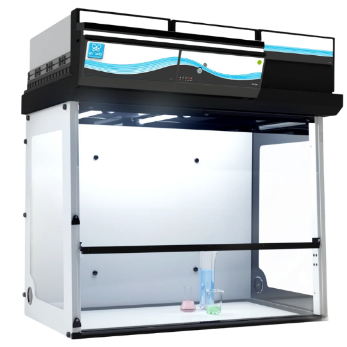 Ductless fume hoods (Captair)
|
 Drug chemistry and controlled substance analysis.
Toxicology sample prep.
Chemical extractions and derivatizations.
Any bench work where known chemistry needs documented containment.
Drug chemistry and controlled substance analysis.
Toxicology sample prep.
Chemical extractions and derivatizations.
Any bench work where known chemistry needs documented containment.
|
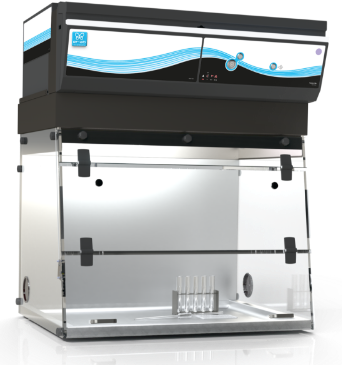 PCR workstations (CaptairBio)
|
Any bench work where known chemistry needs documented containment.
Sample prep where aerosolized DNA is the contamination threat.
Reference sample handling.
Mitochondrial DNA work.
Clean-air workspace that protects evidence from the lab, not the lab from evidence.
|
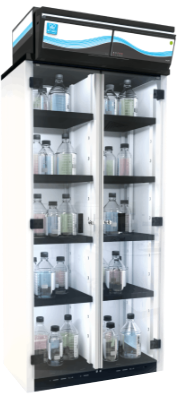 Chemical storage cabinets (CaptairStore)
|
Reagent storage for chemistry units.
Solvent and acid segregation.
Formalin and preservative storage in morgue-adjacent labs.
Any inventory where vapor leakage contaminates neighboring evidence or equipment.
|
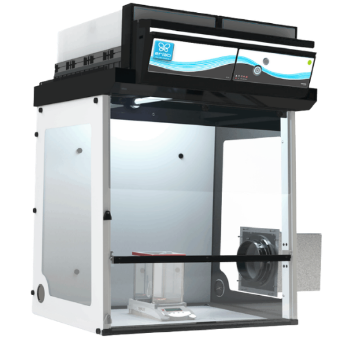 Secure weighing stations
|
Drug quantification, especially for fentanyl analogs and novel psychoactive substances.
Trace powder weighing.
API and controlled substance work.
Any balance application where analyst protection and analytical precision both matter.
|
Fentanyl changed the drug chemistry safety conversation.
Your equipment should reflect that.

A decade ago, a drug chemist’s biggest inhalation risk was ether or toluene. Today it’s a microgram of fentanyl analog on a glove or a balance pan. NIOSH, the DEA, and major forensic accreditors have all tightened guidance on handling trace synthetic opioids. Filtration needs to match the threat.
Captair ductless fume hoods with HEPA-plus-carbon filtration contain powder dispersion at the source and adsorb solvent vapors through chemical-specific filter formulations. Secure weighing stations with HEPA filtration maintain the calm, particle-free environment a microbalance needs, while capturing the powders that would otherwise end up on your analyst’s skin, clothes, and workspace.
The cleanest DNA workspace in your building,
without the construction.
DNA contamination from the lab itself is the hardest kind to defend against. Aerosolized amplicons from previous cases. Skin cells from staff. Environmental DNA from HVAC and foot traffic. CaptairBio PCR workstations give you vertical laminar flow, HEPA or ULPA filtration, and 254-nm UV decontamination in a self-contained unit that installs in hours.
This is especially useful for…

Reference sample handling where a single carry-over invalidates the comparison.
Low-template DNA and touch DNA work where contamination thresholds are nearly zero.
Mitochondrial DNA analysis in labs that also handle nuclear DNA.
Outbuilding and remote lab setups where cleanroom construction isn’t feasible.
Help your lab pass its next audit
instead of explaining it.
ISO 17025, ASCLD/LAB, and ANAB accreditors want to see documented containment performance, maintenance records, calibration data, and chain-of-custody-compatible operating procedures. Erlab equipment generates most of that automatically. That matters most to lab directors and quality managers, who walk into every audit with the receipts already in hand.

What you get with every Erlab installation
ASHRAE 110 containment test results from the installed equipment, not just a factory spec sheet.
Continuous monitoring through eGuard covering face velocity, filter saturation, and alarm history.
Documented chemical validation against 700+ compounds with retention capacity and filter life projections.
MoleCode sensors that detect filter saturation before breakthrough and log every event.
Complete documentation packages for initial qualification (IQ), operational qualification (OQ), and performance qualification (PQ).
Peer references from forensic labs that have navigated similar accreditation reviews.
Erlab Safety Program included
Before you purchase, we review your chemistry and casework profile against our validated database and tell you whether ductless is appropriate for your specific work. Our technicians install, test, and document every piece of equipment. As your casework evolves (new synthetics, new protocols, new accreditation requirements), we revalidate at no additional cost. All of it is included.
Ductless works in buildings
that weren’t built for today’s forensic workflows
Police stations. Courthouses. Evidence rooms. Field labs. A surprising amount of forensic work happens in buildings that were designed for something else. Captair ductless equipment installs anywhere with standard power, no building modifications required.
Police department evidence rooms
Why ductless fits:
Limited square footage, shared HVAC with office space, no roof access. Ductless provides containment without disrupting the rest of the building.

Police department evidence rooms
Why ductless fits:
Limited square footage, shared HVAC with office space, no roof access. Ductless provides containment without disrupting the rest of the building.
County courthouses housing forensic units
Why ductless fits:
Historic buildings with preservation restrictions. No penetrations, no exterior modifications, no disruption to other tenants.
County courthouses housing forensic units
Why ductless fits:
Historic buildings with preservation restrictions. No penetrations, no exterior modifications, no disruption to other tenants.

Field labs and mobile units
Why ductless fits:
Trailers, temporary deployments, and disaster response setups. Plug into standard power and operate within hours.

Field labs and mobile units
Why ductless fits:
Trailers, temporary deployments, and disaster response setups. Plug into standard power and operate within hours.
Satellite labs in existing municipal buildings
Why ductless fits:
Shared HVAC that can’t accept additional exhaust load. Ductless decouples the lab from the building’s ventilation system.
Satellite labs in existing municipal buildings
Why ductless fits:
Shared HVAC that can’t accept additional exhaust load. Ductless decouples the lab from the building’s ventilation system.

Renovated office or industrial space
Why ductless fits:
Growing labs converting existing space into analytical capacity without gutting the building.

Renovated office or industrial space
Why ductless fits:
Growing labs converting existing space into analytical capacity without gutting the building.
When we’ll tell you ductless isn’t the answer.
Some forensic work requires ducted exhaust, and we say so before any purchase.
We don’t sell what isn’t safe.
Applications where ducted hoods remain the right answer:

Perchloric acid digestions or hot acid work (dedicated wash-down systems required).
Unknown or highly variable chemistry outside our validated chemical list.
Large-scale clandestine lab evidence processing with unpredictable synthesis byproducts.
Radioactive material handling.
Any chemistry that can’t be validated through the Erlab Safety Program.
For the drug chemistry, DNA, toxicology, and trace evidence work that makes up the majority of forensic casework, ductless is usually the stronger option on safety, documentation, and facility-flexibility grounds.
Forensic lab
ductless fume hood FAQ
About forensic-specific concerns
How does Captair protect analysts from fentanyl and novel synthetic opioids?
Captair hoods combine HEPA particulate filtration (for powder dispersion) with chemical-specific carbon filtration (for solvent vapors) in a contained, recirculating airflow pattern. Analysts work inside a contained environment with airflow pulling powders and vapors away from the breathing zone. MoleCode sensors monitor filter saturation continuously. We strongly recommend a dedicated weighing station for trace drug quantification where analytical precision and operator protection both matter.
Does ductless equipment maintain chain of custody?
Yes, and it generates supporting documentation automatically. Every Erlab hood logs face velocity, filter status, alarm events, and operating parameters continuously through eGuard. When you need to demonstrate that containment was maintained during a specific analysis window, you can pull the data in seconds. Chain of custody is a procedural concern (who handled what, when). Our equipment supports that procedure by documenting its own performance.
Will this help us with ISO 17025 or ASCLD/LAB accreditation?
Yes. We provide IQ/OQ/PQ documentation, ASHRAE 110 test data, chemical validation records, and continuous monitoring logs. Accreditation is ultimately about your lab's processes, not our equipment alone, but we supply the performance documentation accreditors want to see.
Can DEA-controlled substances be handled in Captair hoods?
The DEA regulates access to controlled substances, not the hood configuration. Most drug chemistry labs that handle controlled substances operate in Captair hoods with appropriate security around the broader lab space. We'll discuss your specific protocols during the Erlab Safety Program review.
How do CaptairBio workstations protect DNA evidence?
HEPA or ULPA filtration (99.995% to 99.99995% efficiency at 0.1 microns) removes aerosolized DNA, skin cells, and environmental particulates from the workspace. Vertical laminar flow creates a positive-pressure barrier between your work and the surrounding lab air. A 254-nm germicidal UV lamp decontaminates the work surface between cases. The combination protects reference samples, low-template DNA, and any work where sample-to-sample carry-over is the contamination threat.
About working with Erlab
How long does installation take, and how disruptive is it?
Most Erlab equipment installs in 2 to 4 hours per unit. Standard electrical connection, no ductwork, no HVAC modifications. Your lab is operational the same day. For crime labs with high casework pressure, we schedule installs around operational needs.
What does the warranty cover, and can it be extended?
Standard warranty comes with every Erlab product. Register the product (takes under two minutes) and protection extends by 10 years. Every time you replace a filter through Erlab, the warranty extends by an additional year.
Is financing or lease-to-own available?
Yes. We offer short-term financing, long-term financing, SLED lease programs for state, local, and federal government buyers, deferred payment, and cash flow recovery options. We also work with most government procurement channels.
Can we move the equipment later if our labs or buildings change?
Yes. Captair hoods, CaptairBio workstations, secure weighing stations, and CaptairStore cabinets are all designed for relocation. When casework volume changes, when municipalities consolidate labs, or when a new building opens, the equipment moves with you.
What does ongoing support look like?
The Erlab Safety Program is included with every purchase at no additional cost. Annual filter assessments, free chemical revalidation when your protocols change, software and monitoring updates, and complete reconfiguration if your work evolves. For labs that want full-coverage maintenance, Erlab Service Plans bundle filter replacements, preventative maintenance, on-call repairs, and compliance documentation into a single predictable annual cost.
How do filter replacements work?
MoleCode sensors continuously monitor filter saturation and alert you before breakthrough occurs. Replacement takes 10 to 15 minutes following documented procedures. Spent filters dispose as regular waste, no RCRA manifests or hazardous waste fees. Your team can handle replacements, or an Erlab Service Plan can handle them on a schedule.
Can we monitor equipment remotely?
Yes. The eGuard platform provides real-time access to filter saturation, face velocity, alarm history, and operating parameters from any connected device. Useful for quality managers tracking performance across multiple units, facility supervisors overseeing a distributed lab network, and accreditation documentation.
Ready to look at your lab?
Whether you’re building a new forensic facility, upgrading an aging crime lab, responding to a fentanyl handling policy change, or trying to fit containment into a building that was never designed for it, let’s discuss what ductless filtration can do for your operation.
