

PROTECT YOUR PEOPLE, SAMPLES, APPLICATIONS, AND FUNDING
From the 1970s-era chemistry building to the new genomics center, Erlab’s ductless fume hoods, PCR workstations, chemical storage cabinets, and ceiling-mounted air purification systems protect your people, your research, and your sustainability targets. Trusted by Harvard, UC Davis, University of Toronto, Wellesley, Lafayette, and 500+ institutions worldwide. Since 1968.


700+ safety validated chemicals

Multiple 3rd-party certifications

$3,900-$6,700 annual savings per replaced hood

Trusted since 1968

Installed in 5000+ institutions worldwide

Up to 94% lower cost to operate
Get a quote in 90 seconds.
Tell us about your labs, your chemistry, and your buildings. A university specialist will get back to you within one business day.
Old buildings. New expectations.
Shrinking budget.
Most university chemistry buildings were designed when energy was cheap, sustainability wasn’t a KPI, and EH&S didn’t report to a president. All of that has changed. The equipment inside those buildings has not.
| On campus you have… | What it costs you |
|---|---|
|
Ductwork that's 30 to 60 years old, corroded, and leaking at every transition.
|
Repair quotes that balloon once contractors open the ceiling. Building envelope work that triggers roof and HVAC rebalancing. |
|
HVAC systems already at capacity, with no make-up air available for new hoods.
|
Research expansion blocked. New faculty hires delayed. Grant-funded equipment that sits in boxes because the lab can't be commissioned. |
|
Carbon neutrality commitments with fume hoods consuming energy equivalent to 3.5 homes each, around the clock.
|
A sustainability office under pressure to show Scope 2 reductions, competing with a facilities budget that prioritizes immediate repairs. |
|
EH&S policies written when filtration couldn't reliably handle mixed chemistry, now outdated.
|
Lab managers working around restrictions instead of solving the underlying ventilation problem. |
|
Teaching lab chemistry that's identical every semester, with ducted hoods pulling conditioned air 24/7 regardless.
|
Operating costs of $4,600 to $9,300 per hood per year on predictable, filterable work. |
|
Historic buildings with preservation restrictions that prohibit roof penetrations or exterior modifications.
|
Fume hoods that can't be added where research actually needs them. |
If any of these describe your campus, there could be a ductless solution that helps.
What we do for university labs
Every Erlab product is built to protect operators without requiring ductwork, roof penetrations, or HVAC modifications. The right equipment depends on the chemistry, the application, and the space.
| Product | Where it fits on campus |
|---|---|
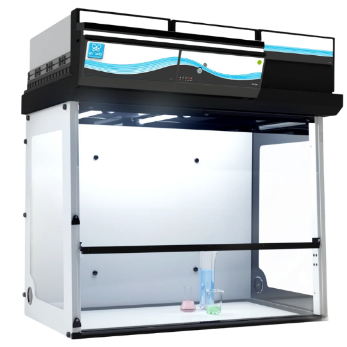 Ductless fume hoods (Captair)
|
 Teaching labs with known, repetitive chemistry.
Histology and pathology formalin work.
QC benches in research support labs.
Organic chemistry in known volumes.
Any application where chemistry is validated through the Erlab Safety Program.
Teaching labs with known, repetitive chemistry.
Histology and pathology formalin work.
QC benches in research support labs.
Organic chemistry in known volumes.
Any application where chemistry is validated through the Erlab Safety Program.
|
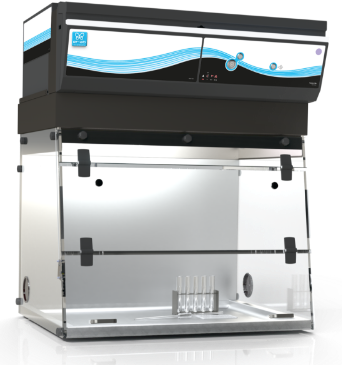 PCR workstations (CaptairBio)
|
Molecular biology teaching labs.
Genomics core facilities.
Clinical research setups.
Forensic biology programs.
Any sample prep where external contamination threatens data integrity.
|
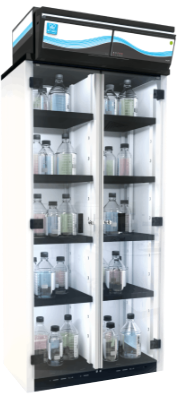 Chemical storage cabinets (CaptairStore)
|
Department-wide acid, solvent, and formaldehyde inventory management.
Teaching stockrooms.
Research prep rooms.
Shared departmental storage where segregation matters and ductwork isn't available.
|
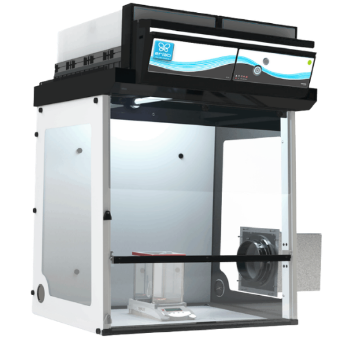 Secure weighing stations
|
API and hazardous dust work in pharmacy schools.
Nanomaterials research.
Materials science preparation.
Any balance application where operator protection and analytical stability both matter.
|
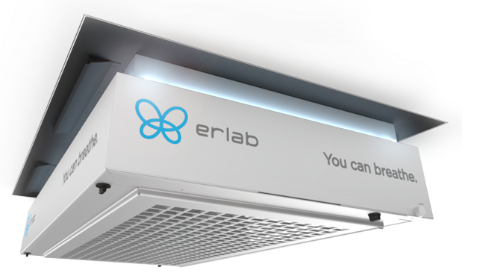 HALO ceiling air purification
|
Research offices.
Common spaces
Seminar rooms.
Libraries.
H14 HEPA plus Carbon AX for VOCs. 50 watts per unit.
|
For EH&S teams
The standards that govern ductless filtration have changed substantially over the last decade. NFPA 45 added explicit ductless sections in its 2024 revision. ANSI/ASSP Z9.5-2022 formally includes ductless in lab ventilation programs. Filtration technology itself has evolved to handle acids, bases, and solvents simultaneously, something conventional activated carbon couldn’t do.
What we bring to every EH&S review
Erlab Safety Program chemical validation packet. Each chemical on your list evaluated against 700+ validated compounds, with documented retention capacity and filter life projections.
ASHRAE 110 containment test results from the actual installed hood, not just a factory spec sheet.
AFNOR NF X 15-211 certification documenting chemical-by-chemical retention below 1% of TLV at exhaust.
Continuous monitoring logs from the eGuard platform covering face velocity, filter saturation, and alarm history.
Peer references from EH&S teams at universities that have approved similar installations.
There are limitations
Ductless is not appropriate for perchloric acid, hot acid digestions, unknown or highly variable research chemistry, significant heat generation, or radioactive materials. We say so during the Erlab Safety Program review, before any purchase. The goal is to deploy ductless on the adjacent known work (powder weighing, formalin, teaching labs, QC) to free up ducted capacity for research that genuinely needs it.
For your sustainability office
Your next Scope 2 reduction is sitting in the chemistry building.
Programs like the University of Chicago’s Shut the Sash campaign have shown that fume hoods are one of the largest controllable energy loads on any campus. Sash closure reduces energy through better behavior. Replacing aging ducted hoods with Captair ductless units is the same argument scaled up, and the savings show up whether anyone remembers to close the sash.
What could your department save?

Ducted hood operating cost:
$4,600 to $9,300 per year (peer-reviewed, climate-dependent).
Captair ductless operating cost:
$700 to $2,600 per year (fan power plus filter replacement).
Annual savings per replaced hood:
$3,900 to $6,700.
Payback from energy alone:
2 to 4 years. Savings continue indefinitely afterward.
The passive savings compound quickly
A 10-year rolling replacement strategy that swaps 2 to 3 hoods per year, starting with the oldest infrastructure and the most predictable chemistry, transforms a chemistry building’s energy profile without requiring a single capital project. Each replacement frees HVAC capacity for the next one. Each reduction shows up in the next sustainability report.
What your office gets that sash-closing alone cannot

Measurable exhaust CFM reduction, documented in integrated monitoring logs.

Auditable Scope 2 reduction suitable for AASHE STARS, Second Nature Climate Commitment reporting, and university-specific carbon targets.

Equipment usage data through eGuard, proving hoods are operating as specified.
Budget predictability as filter replacement costs replace emergency repair surprises.
For facilities and capital planning
Ducted fume hood repairs might not be the best use of budget.
When a ducted hood repair quote includes ductwork modifications, roof work, or HVAC rebalancing, the total cost often exceeds a new Captair ductless hood. You’re comparing repair-plus-infrastructure costs against new-equipment costs. New equipment frequently wins.
For facilities directors
The maintenance economics of ductless are predictable in ways ducted hoods aren’t. No roof penetrations to inspect. No ductwork corrosion discovery. No HVAC rebalancing when a fan fails. Filter replacements on a schedule your team controls, documented automatically through eGuard.

For facilities directors
The maintenance economics of ductless are predictable in ways ducted hoods aren’t. No roof penetrations to inspect. No ductwork corrosion discovery. No HVAC rebalancing when a fan fails. Filter replacements on a schedule your team controls, documented automatically through eGuard.
For capital planners
Ductless enables phased replacement that fits university budget cycles. You don’t need a single large capital project to transform your ventilation economics. Replace opportunistically as hoods fail, as labs renovate, as grants allow. Each replacement is independent, reversible, and documented.
For capital planners
Ductless enables phased replacement that fits university budget cycles. You don’t need a single large capital project to transform your ventilation economics. Replace opportunistically as hoods fail, as labs renovate, as grants allow. Each replacement is independent, reversible, and documented.

The exit strategy
Most universities can’t replace every ducted hood this quarter. A 10-year phased approach means…

Identify replacement candidates (known chemistry, highest maintenance burden).

Replace opportunistically as repairs and renovations come due.

Decommission exhaust infrastructure as it becomes redundant.

Free HVAC capacity, reduce roof maintenance, lower operating costs.
What happened at peer institutions

Wellesley College – Wellesley, MA
Science center renovation, 213,000 sq ft, 39 filtered fume hoods.
$4 million+ projected 20-year net present value.
25,000+ CFM of make-up air eliminated.
Supports campus carbon neutrality by 2040.
Architect: Skidmore, Owings & Merrill. Engineer: BR+A Consulting Engineers.

University of Rochester – Rochester, NY
Organic chemistry teaching lab renovation, 2,400 sq ft, 13 filtered fume hoods.
$136,100 annual operating savings.
$36,000 NYSERDA rebate.
32,727 kWh/year electricity savings.
Contractor: DGA Builders.

Lafayette College – Easton, PA
Rockwell Integrated Science Center, 103,000 GSF, 11 filtered fume hoods.
LEED Platinum.
AIA COTE Top 10 (2021).
73 percent energy reduction vs. 2030 baseline.
Architect: Payette. Engineer: BR+A Engineers.

Butler University – Indianapolis, IN
Chemistry department renovation, 14,500 sq ft, 42 Captair filtered fume hoods and 1 HALO.
$50,000+ annual operating savings.
$66,000 net construction savings. 27 percent faster timeline.
42 percent increase in chemistry program enrollment.
Architect and Engineer: BSA LifeStructures.

Framingham State University – Framingham, MA
New science building, 68,000 GSF, 49 filtered fume hoods.
25 percent smaller mechanical systems.
$330,000 net capex savings.
$24,500 annual net opex savings.
Architect: Ellenzweig. Engineer: BR+A Consulting Engineers.

Marywood University – Scranton, PA
Chemistry lab gut renovations (2012 and 2019), 3,700 sq ft combined, 18 filtered fume hoods.
25-30 percent HVAC load reduction.
~100,000 kWh and $12,000 in annual energy savings.
Low floor-to-floor height accommodated without major mechanical modifications.
Architect: Ellenzweig. Engineer: MEP Engineering.
When Erlab will tell you no
(We don’t sell what isn’t safe)
University research covers every type of chemistry imaginable. Some of it isn’t appropriate for ductless filtration, and we say so before any purchase.
Applications where ducted hoods remain the right answer:
Perchloric acid or hot acid digestions (dedicated wash-down systems required).

Unknown, varied, or highly reactive research chemistry.
Significant heat generation or flammable atmospheres.
Radioactive materials work.
Any chemistry that can’t be validated through the Erlab Safety Program.
For the other 85% of campus applications, where chemistry is known, limited, and predictable, ductless is usually the stronger option on safety, cost, and sustainability grounds.
Ductless fume hoods
FAQs for Universities
About approvals and institutional policy
Our institution has a policy restricting ductless fume hoods. Can Erlab still help?
Probably, yes. Many restrictive policies were written when filtration couldn't reliably handle mixed chemistry. That's no longer a limitation. We'll work within your current policy and, if appropriate, help you assemble the documentation your ventilation committee needs to update it.
How does Erlab handle research chemistry that changes every semester?
We don't recommend ductless for research labs with unknown or highly variable chemistry. We do recommend it for the adjacent predictable work: teaching labs, powder weighing, formalin dispensing, QC benches. Deploying ductless on that work frees ducted capacity for the research that genuinely needs it.
What does the approval process look like on a university campus?
EH&S reviews the chemistry list and filter specifications. Facilities or mechanical engineering reviews airflow and placement. Procurement executes. We provide a complete documentation package for every review, and we can connect you with EH&S peers at institutions that have already approved similar installations.
About projects and sustainability
Can Captair filtered fume hoods qualify for LEED credits?
Yes. Filtered fume hoods have contributed to LEED Platinum certifications at Lafayette College and Bristol Community College, and LEED Gold at multiple other institutions. The specific credit pathway depends on your project scope, but energy reduction from eliminated exhaust load is consistently the largest contribution.
Do utility rebates apply on campus installations?
Often, yes. The University of Rochester received a $36,000 NYSERDA rebate on their filtered fume hood installation. Many state and utility programs offer incentives for HVAC load reduction. Your Erlab rep can help identify applicable programs.
Can we phase replacements across multiple buildings and budget cycles?
Yes. A 10-year rolling strategy that replaces 2 to 3 hoods per year typically transforms a campus's ventilation economics without requiring a single large capital project. Each replacement is independent and documented.
What about teaching labs with hundreds of students?
Captair hoods work well in teaching environments. Known chemistry, controlled volumes, and predictable use patterns are exactly the conditions filtration handles best. Marywood University, Butler University, and Wellesley College all use filtered hoods in teaching labs at scale.
About working with Erlab
How long does installation take, and how disruptive is it?
Most Erlab equipment installs in 2 to 4 hours per unit. Standard electrical connection, no ductwork, no HVAC modifications. Your lab is operational the same day. For larger campus rollouts, we coordinate scheduling around academic calendars.
What does the warranty cover, and can it be extended?
Standard warranty comes with every Erlab product. Register the product (takes under two minutes) and protection extends by 10 years. Every time you replace a filter through Erlab, the warranty extends by an additional year.
Is financing available for university purchases?
Yes. We offer short-term financing, long-term financing, SLED lease programs for state, local government, and education buyers, deferred payment, and cash flow recovery options. We also work with most major higher education GPOs.
Can we move the equipment later if our labs get reconfigured?
Yes. Captair hoods, CaptairBio workstations, and CaptairStore cabinets are all designed for relocation. No building modifications to undo. When labs reconfigure or a department moves buildings, the equipment moves with them.
What does ongoing support look like after installation?
The Erlab Safety Program is included with every Erlab purchase at no additional cost. Annual filter assessments, free chemical revalidation when your inventory changes, software updates for monitoring systems, and complete reconfiguration if your application evolves. For universities that want full-coverage maintenance, Erlab Service Plans bundle filter replacements, preventative maintenance, on-call repairs, and compliance documentation into a single predictable annual cost.
How do filter replacements work?
MoleCode sensors continuously monitor filter saturation and alert you before breakthrough occurs. Replacement takes 10 to 15 minutes following documented procedures. Spent filters dispose as regular waste, no RCRA manifests or hazardous waste fees. Your team can handle replacements, or an Erlab Service Plan can handle them on a schedule.
Can we monitor hoods remotely?
Yes. The eGuard platform provides real-time access to filter saturation, face velocity, alarm history, and operating parameters from any connected device. Useful for EH&S oversight, facilities reporting, and compliance documentation.
Ready to look at your campus?
Whether you’re planning a new building, renovating an aging chemistry wing, trying to hit a carbon neutrality target, or navigating an EH&S approval process, let’s discuss what ductless filtration can do for your institution.
No obligations. No pressure. Just an honest review of what ductless can and can’t do on your campus.
