


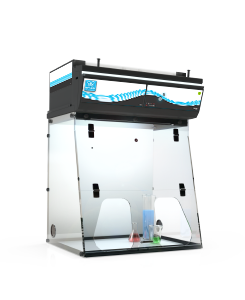
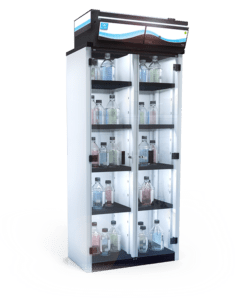
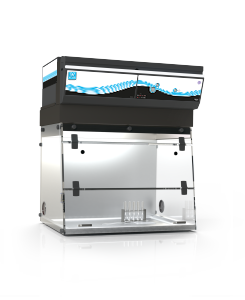

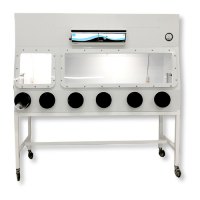
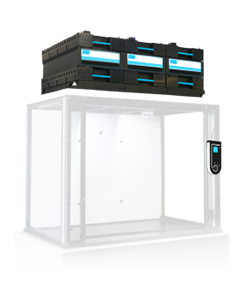
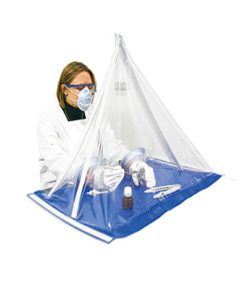

The term “lab efficiency” can mean many things to different people; it all depends upon your point of view. In terms of a flavor and fragrance laboratory, three of the most common interpretations are: energy efficiency, research efficiency and testing efficiency. In all three cases, using filtered, ductless fume hoods and odor control filtration devices will improve lab efficiency.
Energy Efficiency
Nothing in a lab consumes more energy than a ducted chemical fume hood. Ducted hoods consume three to six times the amount of energy of a -80°C ULT freezer. For comparison, a 6 ft wide ductless fume hood consumes just 270 watts of power, with the sash open and the fans at full speed. That’s just one tenth of one ULT freezer or, looked at another way, 30 to 60 times less power than a typical ducted fume hood (see F-1).

If the make-up air demand for the ducted fume hoods in your lab is so great that it exceeds minimum ventilation rates, for at least some periods of time, then the potential exists for reducing the total volume of air being delivered to the lab. That reduction in air volume is where operational cost savings will be generated. Heating, cooling, filtering, dehumidifying and delivering make-up air to labs is very expensive (see F-2). In North America, the typical cubic foot per minute (CFM) of fresh air costs between $5.00 and $8.50 per year in energy costs, and a standard, ducted fume hood can consume between 600 and 1,250 CFM of air. This high operational cost of ducted hoods provides ample savings to offset the costs of replacing filters over time with ductless fume hoods. A ducted, chemical fume hood will not function on its own. Ducted hoods require many complex and expensive HVAC systems to be installed in the building so that air is properly extracted from the hood, and tempered make-up air is delivered into the laboratory. Those systems include:
- Make-up Air Handler Unit (AHU) to temper and supply fresh air to the lab ($$$)
- Hood exhaust fan ($$)
- Hood exhaust ductwork ($)
- Hood exhaust airflow control valve and associated controls ($$)
- Supply air ductwork and insulation ($$)
- Supply air control valve ($$)
- Penthouse or mechanical room space for all of the HVAC systems ($)
- The costs associated with longer construction schedules and delayed occupancy that must be considered when using ducted hoods. ($$ – $$$$)

Ductless hoods, on the other hand, are unitary pieces of equipment that do not require any of these complex HVAC systems. Therefore, when using ductless hoods, many of the HVAC items listed above are eliminated and those remaining can be downsized significantly. Also, the construction schedule can be shortened due to the simplicity of installing ductless hoods.
Independent architects and engineers have determined that the HVAC systems required to make a ducted hood function cost between $20,000 and $25,000 USD for each hood (see F-3). These costs are in addition to the cost of the hood itself. Each lab project will be unique in many ways, and these costs will differ slightly from project to project; however, there are significant HVAC system costs associated with every ducted fume hood that cannot be avoided regardless of the type of ducted hood being used (i.e. from the simple Constant Volume hood to the complex High-Performance fume hood). All ducted hoods require these HVAC systems to make them work properly.
If you are looking to add fume hoods to your lab, or to reduce your lab’s operating costs, consider using ductless fume hoods. Contact your preferred ductless hood manufacturer, and a detailed analysis of your specific application will be performed. The results of this risk assessment will include estimated filter life from which you can calculate operating costs and thus energy efficiency.

The Technology and the Effectiveness of the Removal of Odors and Safety Aspects
Even with the significant savings in energy and overall reduction in construction cost, there are still concerns regarding safety and the product’s efficiency, leaving some to ask, “is it worth the savings?” It is always important to know the manufacture of the products, their history and level of expertise with molecular and particulate air filtration. In order to do this, you must ask the following questions:
- Do you have a published chemical listing of what your “filters” are able to retain and if so, does the listing provide the overall retention capacity expressed in grams?
- This would represent the overall quantity of the chemical which the filter is able to adsorb before there has been detection at the filters exhaust no greater than 1% of the TLV. *As per the AFNOR NFX 15.211*
- This would represent the overall quantity of the chemical which the filter is able to adsorb before there has been detection at the filters exhaust no greater than 1% of the TLV. *As per the AFNOR NFX 15.211*
- How are your chemical handlings validated?
- A chemical questionnaire should be completed by the user and reviewed and validated by a Ph.D. chemist in order to determine the overall efficiency of the filter’s life cycle. *As per the AFNOR NFX 15.211*
- A chemical questionnaire should be completed by the user and reviewed and validated by a Ph.D. chemist in order to determine the overall efficiency of the filter’s life cycle. *As per the AFNOR NFX 15.211*
- Will you be provided with an efficiency report of the filter’s performance?
- A detailed report should be provided showing the efficiency of the filter’s performance, chemicals that will be detected for breakthrough and filter configuration options. *As per the AFNOR NFX 15.211*
These are all critical steps to ensure you are choosing the right manufacturer and have 100% confidence that your safety will never be compromised.
Products Efficiency
With flexible filtration technology, there are many solutions which can be provided:
- Liquid handling and powder application used within the same hood. No turbulence, due to the even distribution of air flow, allows for precise weighing of up to six decimal points. (Ductless filtering fume hoods)
- Removal of any cross contamination within smell and/or taste labs. (Laboratory–air filtration system)
- Storage of samples without the odorous emissions released into other areas of the facility.
- Keeping your samples contained and easily accessible and your facility odor free. (Filtering storage cabinets)
- Removal of nuisance odors present within the facility, not having to go home smelling like your chemistry (Laboratory–air filtration system)
All products should work as a complete ecosystem, delivering clean air throughout your entire facility. This is all accomplished without the need for any upgrades to the building’s infrastructure or the buildings energy load.
