


AN OFFICE AIR PURIFIER THAT COVERS THE ENTIRE FLOOR FROM ABOVE
HALO mounts to the ceiling and runs quietly around the clock, so it never gets unplugged, moved, or forgotten the way a corner unit does.
Most plug-in office air purifiers end up switched off for a call, pushed behind a plant, or cleaning the air around one desk while the rest of the floor goes untouched. HALO is a different kind of air purifier for office spaces. Lab-grade HEPA filtration mounted overhead, covering the whole floorplate, fixed in place so nobody has to remember it.


Covers the whole floor, not one desk

50W, quiet enough to run through calls

Installed overhead, out of reach

Zero floor space used

ASHRAE 241 certified

Filtration since 1968
Get a quote within 1 business day.
Tell us about your office space and we’ll get back to you within 1 business day with the right number of units and pricing.
Why the small office air purifier in the corner stopped working
You bought air purifiers for the office. They are still there, in the corner, by the printer.
Someone switched one off during a meeting because the fan was loud on a call, and never turned it back on. The cleaning crew unplugged one for the vacuum and left it that way. Someone needed the outlet for a laptop charger. It ran all night when the office was empty and sat off through the busy afternoon when it mattered.
Even running, a single floor unit only cleans the air around itself. In an open plan it pushes air sideways at desk height and never reaches the far end of the room, the meeting rooms, or the corridors. To actually cover the floor you would need a row of them, and every one is another thing to switch off, trip over, and forget.
Then there is the filter. With no monitoring, nobody knows when it is spent, so it turns into an expensive fan moving dirty air.
A ceiling air purifier like the HALO removes every one of those failure points. It sits overhead, out of reach, covering the whole floor, running whether or not anyone is thinking about it, telling your facilities team exactly when a filter needs changing.
Corner plug-in unit vs HALO in an office
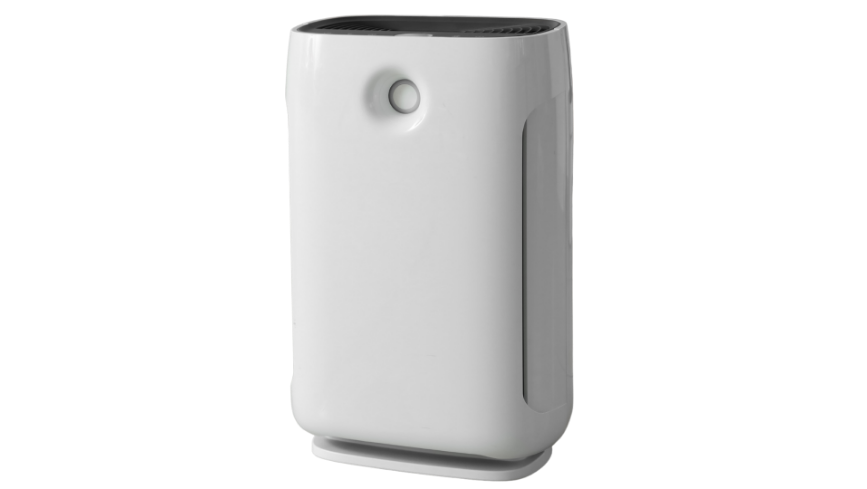
Plug-in desktop or floor unit |
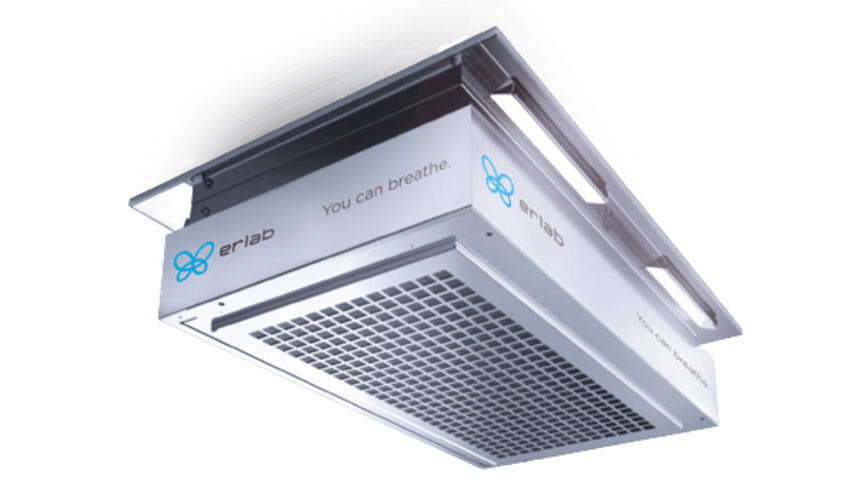
HALO ceiling air purifier |
|
|---|---|---|
| Coverage | One desk or one corner | The whole floorplate |
| Stays running | Until someone unplugs or mutes it | Fixed install, runs around the clock |
| Noise on calls | Often switched off for meetings | Above the occupied zone, stays on |
| Floor space | Takes a desk or a footprint of floor | None, mounted overhead |
| Filter upkeep | Easy to forget until it is useless | Automatic detection, alerts to facilities |
| Tampering | Anyone can move or switch it | Overhead and out of reach |
| Proof for your team | A light on the unit | Live data in the Indoorcare dashboard |
| Filter grade | Often H11 to H13 | HEPA H14 or ULPA U17 |
Plug-in desktop or floor unit
Specifications
Coverage: One desk or one corner
Stays running: Until someone unplugs or mutes it
Noise on calls: Often switched off for meetings
Floor space: Takes a desk or a footprint of floor
Filter upkeep: Easy to forget until it is useless
Tampering: Anyone can move or switch it
Proof for your team: A light on the unit
Filter grade: Often H11 to H13
HALO ceiling air purifier
Specifications
Coverage: The whole floorplate
Stays running: Fixed install, runs around the clock
Noise on calls: Above the occupied zone, stays on
Floor space: None, mounted overhead
Filter upkeep: Automatic detection, alerts to facilities
Tampering: Overhead and out of reach
Proof for your team: Live data in the Indoorcare dashboard
Filter grade: HEPA H14 or ULPA U17

What makes the best air purifier for an office
Shopping lists for the best air purifier for an office are full of desktop boxes built for a bedroom. An office floor is a different problem. Here is what actually matters once you scale past a single room.
- Coverage across the whole floorplate. A desktop unit cleans the air around one chair. An office needs filtration that reaches every workstation, meeting room, and corridor.
- It keeps running with nobody tending it. The best unit is the one no one has to remember. Mounted overhead and fixed in place, HALO cannot be switched off for a call or unplugged by the cleaning crew.
- It stays quiet. A loud purifier gets turned off, which makes it worthless. HALO runs above the occupied zone at low noise, so it stays on.
- It costs you no floor space or visual clutter. Offices are designed spaces. A box with a cord in the corner is the opposite of designed. HALO is invisible overhead.
- It proves it is working. The best air purifier for an office hands facilities and leadership real data, not a colored light on a casing.
How the HALO ceiling air purifier works
HALO hangs from the ceiling and connects to building power overhead. No ductwork, no HVAC changes, installed in hours.

Air is drawn upward.
Room air is pulled up into the unit, lifting particles and contamination away from the desks and breathing zone below.

Lab-grade filtration.
Air passes through HEPA H14, ULPA U17, or Neutrodine activated carbon, the same filter grades Erlab builds into laboratory biosafety cabinets.

Clean air returns at the ceiling.
Filtered air rides the ceiling outward and cascades back down slowly, keeping the whole floor mixing instead of stirring one corner.
A Smart-Light ring shows status at a glance, and the eGuard app gives facilities remote monitoring, alerts, and filter detection. Nothing for staff to manage.
The meeting room nobody wants to be in by 3pm
Pack people into a closed meeting room for an hour and the air changes. CO2 climbs, and VOCs build up off people, furniture, carpet, and cleaning products. Research links rising CO2 and VOC levels to measurable drops in focus and decision-making, which is a real cost when the room is full of the people you pay to make decisions.
HALO carbon models pull VOCs out of the air directly. CO2 is a ventilation problem rather than a filtration one, so Erlab AirGradient monitors track it in real time and tell you when a room needs more fresh air. You get clean air at the particle and chemical level, plus the data to manage ventilation on top of it.

How many units does your space need?
Coverage comes down to room volume and the air change rate you want to hit. Each HALO 35 P moves about 10,590 cu ft of air per hour.
Small meeting room
Conference room
Open-plan zone
Full floor
Room volume
13,500 cu ft
Clean air needed
40,500 cu ft/h
HALO 35 P units
4 units
Example estimates, at the listed ceiling heights:
| Office space | Size | Volume | Target ACH | HALO 35 P units |
|---|---|---|---|---|
| Small meeting room (9 ft ceiling) | 150 sq ft | 1,350 cu ft | 4 | 1 units |
| Conference room (9 ft ceiling) | 400 sq ft | 3,600 cu ft | 4 | 2 units |
| Open-plan zone (9 ft ceiling) | 1,500 sq ft | 13,500 cu ft | 3 | 4 units |
| Full floor (9 ft ceiling) | 5,000 sq ft | 45,000 cu ft | 2 | 9 units |
A planning estimate only. Layout, partitions, and headcount all affect placement, and every order includes a coverage consultation that scopes the real number for your floor.
Give your team proof, not promises
Bringing people back to the office is easier when you can show them the air is clean rather than tell them. HALO connects to Erlab’s three-step program so you can do exactly that.

Step 1
Assess
Erlab AirGradient monitors track CO2, PM2.5, VOCs, temperature, and humidity in real time, so you start from what your air is actually doing, floor by floor.

Step 2
Address
HALO units go in where the data points, ceiling-mounted and always on, covering the open plan and the meeting rooms that need it most.

Step 3
Assure
The Indoorcare dashboard turns it into something you can share, a live wellness score and reporting for employees, facilities, and leadership.
Tested in real offices to be the best office air purifier
In an independent test by 3Flow, a single HALO P running in a 261 sq ft office during 50 minutes of continuous speaking cut the inhaled dose of fine particles by 62 to 74%, depending on particle size. Ventilation effectiveness improved by 27%, roughly the equivalent of adding two extra air changes an hour without touching the HVAC.

62 to 74% lower particle dose
Measured in an occupied office during continuous speaking, the everyday condition of a meeting or a busy open plan.
+27% ventilation effectiveness
The room mixed and cleared far more like a well-ventilated space, with no ductwork changes.
99.99% viral reduction
In separate ARE Labs chamber testing, HALO P cut aerosolized MS2 virus, a stand-in for flu and SARS-CoV-2, by 99.99% within 90 minutes.
What the HALO air purifier for commercial bulding costs to run
| Cost component | HALO ceiling air purifier | Plug-in desktop units | Adding HVAC capacity |
|---|---|---|---|
 Coverage of a full floor
|
A planned set of overhead units | A unit per desk or zone, and they still miss the gaps | Major mechanical work |
 Electricity
|
50W per unit, about $52.60 a year each at $0.12 per kWh | Adds up across many units left running unmanaged | Heavier fan load plus conditioning all that outside air |
|
Filters
|
Automatic detection, roughly $0.48 a day all-in per unit | Forgotten until the unit is just a fan | Separate HVAC filter costs |
 Upkeep
|
Out of reach, monitored remotely | Switched off, unplugged, never serviced | Needs mechanical access to service |
 Proof it works
|
Live data in Indoorcare | A light on the casing | A separate monitoring spend |
The roughly $0.48 per day figure is an illustrative example covering electricity and amortized filters, based on published Erlab data. Real filter intervals shift with the office and how busy it is.
The questions your team will raise
| The concern | The reality | How we help |
|---|---|---|
| We already bought plug-in purifiers. | Each one cleans the air around a single desk, and most end up switched off or unplugged. A few ceiling units cover the whole floor and stay on. | A walkthrough maps your floor and shows the coverage gaps your current units leave. |
| Will employees even notice? | They notice the stuffy meeting room and the 3pm headache. With Indoorcare you can show them, and yourself, that the air actually changed. | We set up monitoring first, so the before-and-after is your own data, not our claim. |
| Facilities is worried about install. | HALO hangs from the ceiling grid and connects to power overhead. No ductwork, no construction, hours rather than weeks. | A site visit with your facilities team confirms placement and power before anything is ordered. |
| Finance wants the ROI. | Fewer sick days, no repeat buying of disposable units that get ignored, support for wellness and return-to-office goals, and 50W per unit. | We will build the numbers around your headcount, floor area, and current spend on disposable units. |
| It will be noisy in an open plan. | HALO runs above the occupied zone at low noise, which is the whole reason it stays on when desktop units get muted. | We can share acoustic specs and arrange a visit to a working install in an office like yours. |
| Does it clean the air or just move it? | It removes contaminants. Air is pulled up through HEPA or carbon filtration and returned clean, rather than pushed around the room like a fan does. | Independent test data, including a real-office study, shows the measured reduction, not just airflow. |
Ceiling mounted air purifier
frequently asked questions.
The basics
Is HALO better than a plug-in office air purifier?
For a single desk, a small plug-in unit is fine. For an actual office floor it falls short, because it only cleans its immediate area and tends to get switched off or unplugged. HALO is a ceiling air purifier that covers the whole floorplate, stays out of reach so it keeps running, and reports its status to your facilities team. Different scale, different job.
What is the best air purifier for an open-plan office?
The best air purifier for an office is the one that reaches every desk, stays on without anyone managing it, runs quietly enough that nobody turns it off, and proves it is working. Desktop boxes struggle on all four counts at floor scale. A ceiling-mounted system like HALO is built for exactly that situation, which is why it is a better fit for an open plan than a row of plug-in units.
Coverage and sizing
How many units does an office floor need?
It depends on the floor area, ceiling height, and how the space is divided. As a rough guide, a 1,500 sq ft open-plan zone at 3 air changes an hour needs about four HALO 35 P units, and a 5,000 sq ft floor at 2 air changes needs about nine. A coverage consultation sets the real number for your layout.
Is it quiet enough to run during meetings and calls?
Yes, and that is the point. HALO runs above the occupied zone at low noise, so unlike a desktop unit next to someone on a call, there is no reason to switch it off. Staying on is most of what makes an air purifier useful.
Can employees unplug it or turn it off?
No. HALO is installed overhead and out of reach, so it cannot be unplugged for a vacuum or muted for a meeting the way a floor unit can. Confirm the exact power connection with your Erlab specialist for your building.
Air quality
Does HALO remove CO2 from a stuffy meeting room?
No, and no air purifier does. CO2 is a ventilation issue, handled by bringing in fresh air. HALO removes particles, and its carbon models remove VOCs, while Erlab AirGradient monitors CO2 in real time so you know when a room needs more ventilation. Filtration and ventilation solve different parts of the problem.
What does it actually filter?
The HEPA models capture fine particles, including viruses, bacteria, mold, and allergens, down to the grade used in laboratory biosafety cabinets. The carbon models capture VOCs and odors off furniture, cleaning products, and people. You can mix models across a floor based on what your monitoring finds.
Install and cost
Can it go into a leased office?
Usually yes. HALO mounts to the ceiling grid and connects to power overhead, with no ductwork or construction, so it goes in fast and cleanly. Because it is a fixed install, talk to us and your landlord about the right approach for your lease.
How does the cost compare to buying desktop units?
Desktop units look cheap until you count one per desk, the filters nobody replaces, and the fact that half of them are switched off. A planned set of ceiling units covers the same floor, stays on, runs at 50W each, and reports its status. We will build the comparison around your headcount and current spend.
What standards does HALO meet?
HALO 35 P meets EN 1822:2019 for its HEPA and ULPA filters, plus ASHRAE 241, UL, and CE. HALO 35 C meets AFNOR NF X 15-211:2009, the strictest molecular filtration standard, along with UL and CE. ASHRAE 241 is the 2023 standard for controlling infectious aerosols indoors, and no US jurisdiction requires it yet, so treat it as a strong third-party benchmark rather than a legal requirement.
Ready to clear the air in your office?
Tell us about your space and we will put together a coverage plan, the right mix of units, and pricing. No obligation, no sales pressure.
