



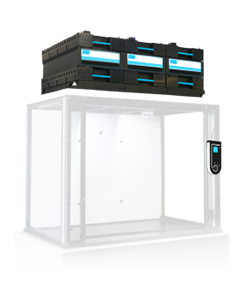

Ohaus balance & Erlab ductless filtering fume hood
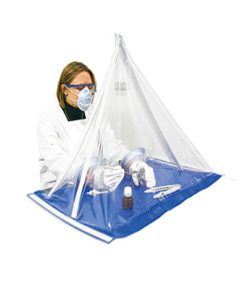
The purpose of this paper is to show that accurate weighing results can be attained when choosing the proper combination of a balance within the appropriate ductless filtering fume hood. Weighing requires accuracy, especially when the readability of a balance reaches 0,01 mg or more. In many applications the samples being weighed might be harmful or dan-gerous for the operator to inhale and the use of a filtered fume hood is required for the protection of the laboratory personnel. When using a hood, air flow, drafts, and vibrations can adversely affect the weighing perfor-mance of a balance and eventually cause errors to the measurement.
Equipment
Ductless Filtering Fume Hood
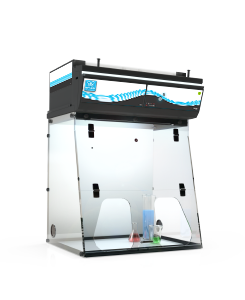
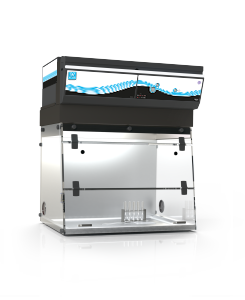
For protection of the operator an Erlab Captair 391 Ductless Filtering Fume Hood is selected because it is specifically designed to protect users against inhalation of chemi-cals while also accommodating the specific requirements needed for the use of a balance. This hood complies with international safety standards, such as AFNOR NF X 15:211. To comply with this standard, face velocities of the unit must be maintained between 0.4 and 0.6 m/s which requires a total airflow equal to around 220 m3/h. Despite this airflow, the unit is designed to minimize the turbulence that occurs in the enclosure and absorb the vibration that is generated by the fan. The hood was also equipped with a Trespa ToplabPlus work surface to minimize conduction of vibration to the balance.

Balance
Choosing a quality balance with applicable features will ensure a high accuracy of weighing. The Ohaus Explorer Semi-Micro balance is a modular model that easily fits within the fil-tered fume hood. To keep the vibration to a minimum, the balance includes a set of four infrared sensors to engage the automatic doors, an ionizer, and a grid pan. The display can be separated from the base of the balance to a distance of 1.5m with a standard cable. The automatic doors as well as the ionizer, tare and a number of other commands can be actioned with the use of four infrared sensors. This way there is no need for the operator to touch the balance during the weighing procedure which both adds to the protection of the operator as well as minimizes disturbances influencing the balance’s performance. The grid pan helps the balance to stabilize up to 1 s faster. The model used for validation was the Explorer EX225D/AD equipped with an accessory grid pan. Balance’s readability is 0,01 mg up to 120g capacity and 0, 1 mg from 120g to the full capacity of 220g.

Validation Procedure
Testing
All tests were performed twice, with and without the air flow turned on and in both cases the results obtained were within the limits of PN-EN 45501 for Non-Automatic Weighing Instruments.
The validation process has been performed by an independent party, Pesage Creuen Mi-chel. A set of calibrated weights were used. The class of calibrated weight was E2. All weights were certified on the 18th of June 2015, by SPF Economie ( certificate number: E6/ SMD-ENS/2015/011055.). The set of calibrated weights was comprised of the following: 1 mg, 2 mg, 2*mg, 5 mg, 20 mg, 20*mg, 50 mg, 100 mg, 200 mg, 200*mg, 500 mg, 1 g, 2 g, 2*g, 5 g, 10 g, 20 g, 20* g, 50 g, 100 g, 200 g. All calibrated weights comply to 71/317/ CEE (26th of June 1971) and to 74/1478/CEE (4th of March 1974).
The following tests have been performed:
- Performance test without tare
- Eccentricity
- Repeatility
Test Results
Weighing performance without tare
Two test procedures have been performed, up to maximum 120g and 220g capacity se-parately. Both of these were done with and without the air flow turned on. Without air flow within the normal parameters of balance usage as compared to usage of a balance in a filtered fume hood. This ensures that the comparison is of equal stature. For each procedure a selection of test weights was placed on the pan in ascending and descending order. In both cases, for each maximum capacity, the results obtained were within the limits of maximum permissible errors as described in the norm.


| Reference weight (g) | Upper permissible deviation (g) | Ascending Gap (g) | Descending Gap (g) | Lower permissible deviation (g) |
| 0.001 | 0.001 | -0.00001 | -0.00014 | -0.001 |
| 20 | 0.001 | -0.00009 | -0.00022 | -0.001 |
| 40 | 0.001 | -0.00018 | -0.00029 | -0.001 |
| 50 | 0.001 | -0.00015 | -0.00032 | -0.001 |
| 50 | 0.002 | -0.00015 | -0.00032 | -0.002 |
| 60 | 0.002 | -0.00020 | -0.00034 | -0.002 |
| 80 | 0.002 | -0.00023 | -0.00038 | -0.002 |
| 100 | 0.002 | -0.00025 | -0.00038 | -0.002 |
| 120 | 0.002 | -0.00027 | -0.00044 | -0.002 |
| 140 | 0.002 | -0.00030 | -0.0005 | -0.002 |
| 160 | 0.002 | -0.00030 | -0.0004 | -0.002 |
| 180 | 0.002 | -0.00050 | -0.0006 | -0.002 |
| 200 | 0.002 | -0.00060 | -0.0007 | -0.002 |
| 200 | 0.003 | -0.00060 | -0.0007 | -0.003 |
| 220 | 0.003 | -0.00070 | -0.0008 | -0.003 |
Table 1. Recorded Deviation between measured values and reference weight with fan of the fume hood turned on. Balance range up to 220g.
| Reference weight (g) | upper permissible deviation (g) | Ascending Gap (g) | Descending Gap (g) | Lower permissible deviation (g) |
| 0.001 | 0.001 | -0.00001 | 0.00019 | -0.001 |
| 2 | 0.001 | 0.00003 | 0.0002 | -0.001 |
| 4 | 0.001 | 0.00005 | 0.00025 | -0.001 |
| 5 | 0.001 | 0.00010 | 0.00023 | -0.001 |
| 6 | 0.001 | 0.00010 | 0.00023 | -0.001 |
| 10 | 0.001 | 0.00016 | 0.00016 | -0.001 |
| 20 | 0.001 | 0.00017 | 0.0002 | -0.001 |
| 50 | 0.001 | 0.00012 | 0.00013 | -0.001 |
| 50 | 0.002 | 0.00012 | 0.00013 | -0.002 |
| 100 | 0.002 | 0.00004 | 0.00011 | -0.002 |
| 120 | 0.002 | 0.00006 | 0.00003 | -0.002 |
| 121 | 0.002 | 0.00010 | 0.0001 | -0.002 |
Table 2. Recorded Deviation between measured values and reference weight with fan of the fume hood turned on. Balance range up to 120g.
Eccentricity
Since the balance is a dual range instrument, two test procedures have been executed. For the 0,01 mg readability range a 40g test weight has been used and for the upper range with 0, 1 mg readability a 70g and 75g test weight load has been used. Tests were performed both with and without the air flow turned on. Obtained results met the criteria described in the norm.

Figure 1: location of eccentricity measuring points.
| Location | Reference weight (g) | Measured value (g) | Maximum permissible deviation (g) | Deviation (g) |
| 1 | 75.000 | 75.0000 | 0.002 | 0.0000 |
| 2 | 75.000 | 75.0006 | 0.002 | 0.00006 |
| 3 | 75.000 | 75.0004 | 0.002 | 0.00004 |
| 4 | 75.000 | 74.9999 | 0.002 | -0.0001 |
| 1 | 70.000 | 69.99980 | 0.002 | -0.00020 |
| 2 | 70.000 | 69.99978 | 0.002 | -0.00022 |
| 3 | 70.000 | 69.99979 | 0.002 | -0.00021 |
| 4 | 70.000 | 69.99976 | 0.002 | -0.00024 |
Table 3: Results of eccentricity test with 70g and 75g test weight. Fan of the fume hood turned on. Balance up to 220g.
| Location | Reference weight (g) | Measured value (g) | Maximum permissible deviation (g) | Deviation (g) |
| 1 | 40.000 | 40.0001 | 0.001 | 0.0000 |
| 2 | 40.000 | 40.0002 | 0.001 | 0.00006 |
| 3 | 40.000 | 40.0003 | 0.001 | 0.00004 |
| 4 | 40.000 | 39.9999 | 0.001 | -0.0001 |
Table 4: Results of eccentricity test with 40g test weight. Fan of the fume hood turned on. Balance up to 120g.
Repeatability
Similar to the previous test procedures, repeatability tests have been performed sepa-rately for the 120g and 220g weighing ranges. For the 0,01 mg readability range two test weights have been used, namely 60g and 120g. The remaining range with 0, 1 mg reada-bility has been tested with 1 00g and 200g test weights respectively.
| Location | Reference weight (g) | Measured value (g) | Maximum permissible deviation (g) | Deviation (g) |
| 1 | 100.000 | 100.00004 | 0.002 | 0.00004 |
| 2 | 100.000 | 100.00001 | 0.002 | 0.00001 |
| 3 | 100.000 | 100.00009 | 0.002 | 0.00009 |
| 4 | 100.000 | 100.00004 | 0.002 | 0.00004 |
| 5 | 100.000 | 100.00015 | 0.002 | 0.00015 |
Table 5. Results of repeatability test with 100 g test weight. Fan of the fume hood turned on. Balance range up to 220 g.
| Location | Reference weight (g) | Measured value (g) | Maximum permissible deviation (g) | Deviation (g) |
| 1 | 200.000 | 200.00020 | 0.002 | 0.00020 |
| 2 | 200.000 | 200.00030 | 0.002 | 0.00030 |
| 3 | 200.000 | 200.00020 | 0.002 | 0.00020 |
| 4 | 200.000 | 200.00030 | 0.002 | 0.00030 |
| 5 | 200.000 | 200.00030 | 0.002 | 0.00030 |
Table 6. Results of repeatability test with 200 g test weight. Fan of the fume hood turned on. Balance range up to 220 g.
| Location | Reference weight (g) | Measured value (g) | Maximum permissible deviation (g) | Deviation (g) |
| 1 | 60.000 | 60.00006 | 0.002 | 0.00006 |
| 2 | 60.000 | 60.00000 | 0.002 | 0.00000 |
| 3 | 60.000 | 60.00002 | 0.002 | 0.00002 |
| 4 | 60.000 | 60.00004 | 0.002 | 0.00004 |
| 5 | 60.000 | 60.00003 | 0.002 | 0.00003 |
Table 7. Results of repeatability test with 60 g test weight. Fan of the fume hood turned on. Balance range up to 120 g.
| Location | Reference weight (g) | Measured value (g) | Maximum permissible deviation (g) | Deviation (g) |
| 1 | 120.000 | 120.00001 | 0.002 | 0.00001 |
| 2 | 120.000 | 120.00004 | 0.002 | 0.00004 |
| 3 | 120.000 | 120.00005 | 0.002 | 0.00005 |
| 4 | 120.000 | 120.00007 | 0.002 | 0.00007 |
| 5 | 120.000 | 120.00005 | 0.002 | 0.00005 |
Table 8: Results of repeatability test with 120 g test weight. Fan of the fume hood turned on. Balance range up to 120 g.
Conclusion
Test results show that the balance’s performance when placed under a filtered fume hood during normal operation does not change drastically, allowing the balance to perform within the limits stated in the EN-PN 45501 for Non-Automatic Weighing Instruments.
Vibrations and air-flow disturbances caused by the Captair 391 Ductless Filtering Fume Hood have no negative effect on EX225D/AD performance. The combination of the Ohaus balance and Erlab hood allows for both safe and accurate measurements.

