




Sustainable labs and ASHRAE (American Society of Heating, Refrigerating and Air-Conditioning Engineers) standards are closely related when it comes to designing and operating energy-efficient and environmentally friendly laboratory facilities. ASHRAE standards provide guidelines and best practices for various aspects of building systems, including heating, ventilation, air conditioning, and energy efficiency. These standards are often referenced and followed in the design and operation of sustainable labs.
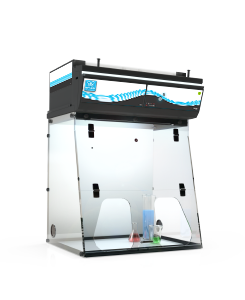
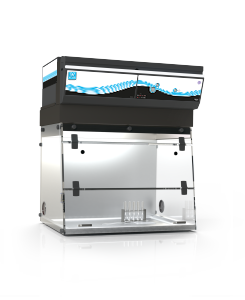
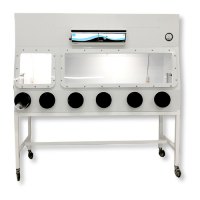
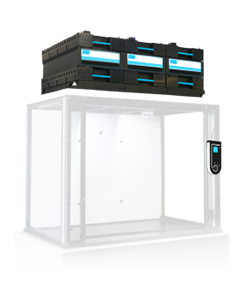
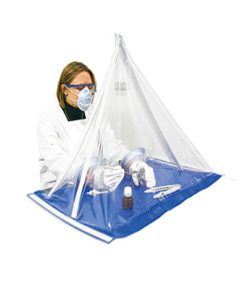
Erlab’s Captair Ductless Filtering Fume Hoods and Powder Weighing Stations are 100 percent ductless, meaning they don’t require any HVAC connection. Some models can be placed on mobile bases to be wheeled around or shared between laboratories. These units offer end users protection from particulate and/ or liquid handlings, and they are cleanroom compliant with HEPA at the exhaust. Customers can weigh down to six decimal places without interruption of the scale.
With Erlab’s unique ValiQuest or eValiQuest validation process, safety is guaranteed, and chemical exposure is eliminated by the configurable filtering system above the enclosure. Installation is simple and no ductwork is necessary, allowing for easy relocation of units. Furthermore, each unit is equipped with Smart Technology, an exclusive suite of tools including Smart-Light Communication™, optional chemical sensors, real-time status, and the eGuard app. This technology provides an easily identifiable method of communication regarding containment, performance, and filter efficiency via a soft LED band of light called Smart-Light, a light signature on the unit’s front panel that casts a stable LED glow ensuring proper operation.
Here are a few key areas where ASHRAE standards are relevant to sustainable labs:

Energy Efficiency
ASHRAE Standard 90.1 outlines energy efficiency criteria for buildings, offering benchmarks and recommendations to reduce energy consumption in labs. Sustainable labs aim to minimize energy usage through efficient HVAC systems, lighting controls, and equipment selection. ASHRAE standards can help inform and guide those efforts.
Indoor Air Quality (IAQ)
ASHRAE Standard 62.1 addresses IAQ and ventilation requirements for commercial buildings, including labs. Sustainable labs prioritize maintaining healthy IAQ while minimizing energy consumption. ASHRAE guidelines on ventilation rates, filtration, and air distribution can help sustainably achieve optimal IAQ.
Thermal Comfort
ASHRAE Standard 55 provides guidance on thermal comfort in indoor environments. Sustainable labs aim to provide a comfortable working environment for occupants while minimizing energy use. Following ASHRAE recommendations on temperature, humidity, and air movement can contribute to both comfort and energy efficiency.
Refrigeration and Cooling Systems
ASHRAE standards, such as Standard 15 for refrigeration safety and Standard 34 for refrigerant selection, are relevant to lab facilities that require refrigeration and cooling systems. Sustainable labs may prioritize low-global warming potential (GWP) refrigerants and energy-efficient cooling technologies, aligning with ASHRAE guidelines.
By considering and implementing ASHRAE standards, sustainable labs can optimize their energy performance, indoor environmental quality, and overall environmental impact. These standards provide a recognized and widely accepted framework for designing and operating labs that are both sustainable and conducive to scientific research and experimentation.

Standard 241-2023 for infectious aerosol control
ASHRAE has recently released a new standard, 241-2023 Control of Infectious Aerosols, with strong suggestions that the guidelines contained within be followed by laboratories and all commercial industries. This new standard establishes the minimum requirements aimed at diminishing disease transmission through possible infectious aerosol contamination in new, existing, and renovated buildings.
Adding more outside air (OA) and increasing air exchange rates are the only ways to effectively reduce the risk of airborne transmission. In fact, the ASHRAE 241 standard sets a guideline of four to six full-volume air changes per hour (ACH). While this is undoubtedly an effective method, the increase in the building’s overall energy load can become significant. For example, achieving four ACH in a 20,000 cu’ space requires an airflow of 1,333 cfm. To meet this level of airflow, using an average electricity cost of $0.11 per kWh, a facility would have an annual operational cost of approximately $7,800 with about 41,000 lbs. of CO2 emissions. So, how does this approach fit into sustainability?
What ASHRAE has done with the 241 standard is challenge alternative solutions for equivalent air change rates (eACH). This allows facilities to look at more sustainable and financially viable solutions to ensure their buildings are well-equipped to manage the mitigation requirements for reducing exposure to viral loads and therefore infections. The methods outlined in the ASHRAE 241 standard test the efficacy of the product performance challenge test as set forth by the task force committee and ensure that no harmful by-products are released during air treatment.
Erlab has long understood the need for standards to be put in place for IAQ improvements and is the first mechanical air filtration company to be certified through an independent agency (ARE Labs ASHRAE 241 ERLAB test results) to meet or exceed the criteria as outlined in the ASHRAE 241 standards.
Additional notable ASHRAE recommendations
ASHRAE Standard 189.1
This standard, titled “Standard for the Design of High-Performance Green Buildings,” provides comprehensive guidelines for the design, construction, and operation of sustainable buildings, including laboratory facilities. It covers various aspects such as energy efficiency, water efficiency, indoor environmental quality, and site sustainability.
ASHRAE Standard 90.1
This standard, titled “Energy Standard for Buildings Except Low-Rise Residential Buildings,” sets the requirements for energy efficiency in buildings. It provides guidelines for the design of building systems, including HVAC and lighting, to achieve energy savings. Compliance with this standard is often required by building codes and regulations.
ASHRAE Standard 62.1
This standard, titled “Ventilation for Acceptable Indoor Air Quality,” addresses ventilation requirements to maintain acceptable indoor air quality in commercial buildings, including labs. It provides guidelines for determining ventilation rates, air filtration, and other aspects related to indoor air quality. ASHRAE Standard 55: This standard, titled “Thermal Environmental Conditions for Human Occupancy,” focuses on thermal comfort in indoor environments. It provides guidance on factors such as temperature, humidity, and air movement to ensure occupants’ comfort and well-being.
ASHRAE Standard 170
This standard, titled “Ventilation of Health Care Facilities,” specifically addresses ventilation requirements for healthcare facilities, which can include laboratories. It provides guidelines for air exchange rates, filtration, and other considerations to maintain a healthy indoor environment.
These standards provide valuable guidance and requirements that can be applied to sustainable lab design and operation. They are widely recognized and used in the industry to promote energy efficiency, indoor air quality, and overall sustainability in building projects, including laboratory facilities.
Providing solutions along the ASHRAE path
Once the directives from ASHRAE standards have been accepted as the best path to safety and sustainability for concerned organizations, it is essential to highlight a course of action that can assist with compliance and sustainability requirements. Erlab’s suite of ductless filtering products stands out in this context. All Erlab ductless filtering products provide protection from chemicals, particles, and biologicals (Class 1) with a combination of carbon and/or HEPA filtration. These systems contribute to the eACH recommended by ASHRAE, reducing the required OA and minimizing HVAC requirements.
Benefits for staff and their environment

Guaranteed safety
Comprehensive chemical assessments and filtration products work in sync for total clean air protection

Sustainability
Achieve LEED or ZNE status and significantly reduce your facility’s energy consumption and carbon footprint
Expanding the lab ecosystem
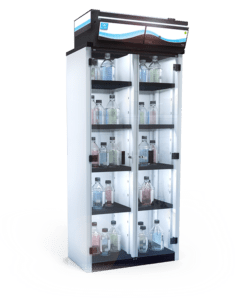
In addition to ductless filtering fume hoods, Erlab offers HALO ceiling-mounted air filtration systems (whose certification is the focus of the ASHRAE 214 report and a filtration solution for quality indoor air), ductless chemical filtering storage units, and safety cabinet chemical filtration. All products can work in coordination for a complete lab ecosystem, assuring safety, sustainability, and simplicity of operation at their core.
If you are seeking assistance to convert relevant ASHRAE standards into practice at your lab or facility, ask the professional safety experts at Erlab how we can help.
