


Introduction
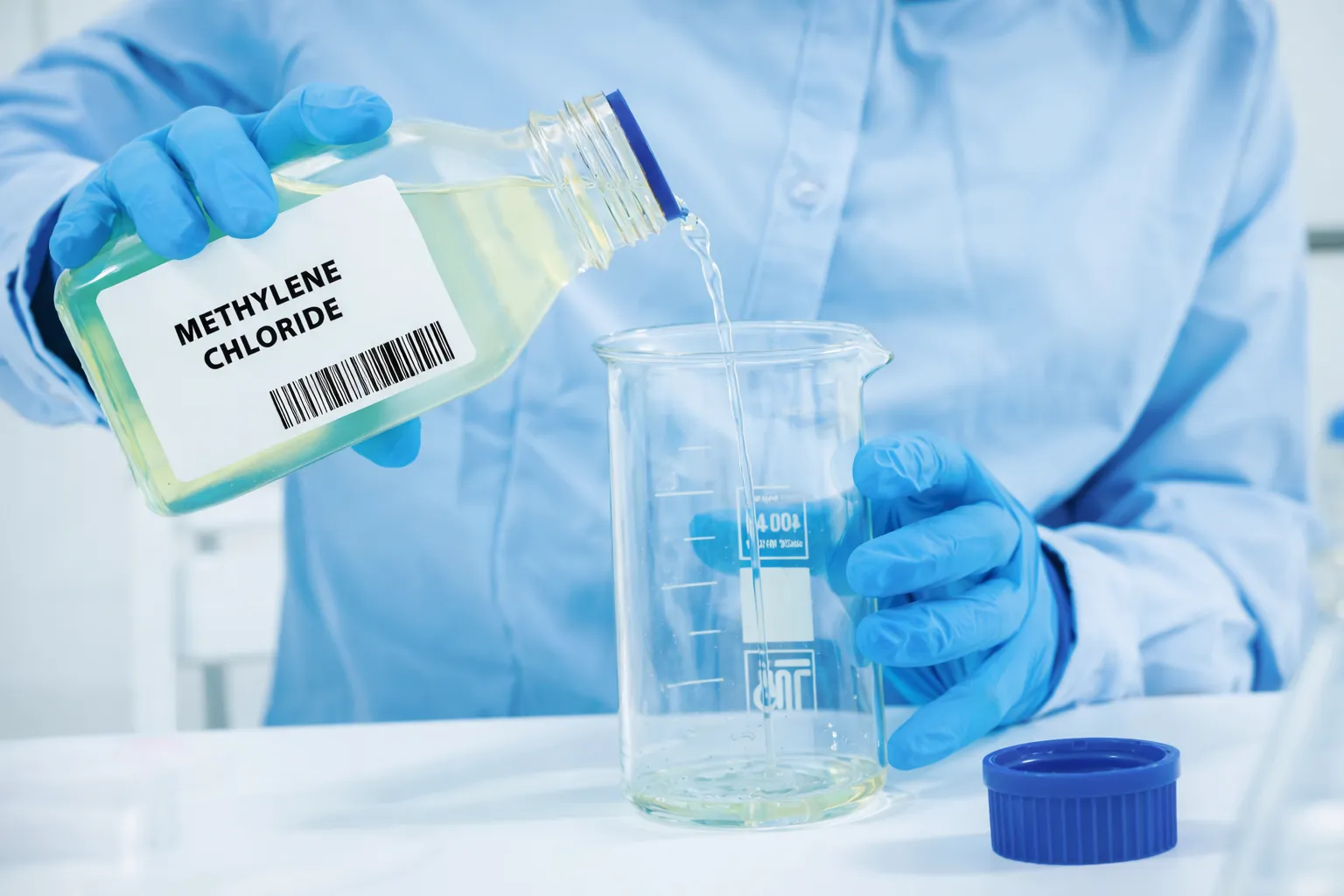
In November 2022, the U.S. Environmental Protection Agency (EPA) updated its regulations regarding the risk determination of methylene chloride. This revised version concludes that this chemical substance poses a harmful risk to health. The main health risks identified are: neurotoxicity due to short-term exposure, effects on the liver and cancer risk due to long-term exposure.
The new EPA regulations have significantly reduced the exposure threshold compared to the OSHA (Occupational Safety and Health Administration) standard, as shown by the Figure 1.
| Rule | OSHA | New EPA |
|---|---|---|
| 8-Hour Time Weighted average (TWA) | 25 ppm | 2 ppm |
| 15-Minute Short Term Exposure Limit (STEL) | 125 ppm | 16 ppm |
| Action Level | 12.5 ppm | 1 ppm |
Figure 1: Comparison of OSHA’s Methylene Chloride Exposure Limits with the New EPA Regulations
In accordance with the requirements of the NFX 15-211 standard for the protection of laboratory operators, a Class 1 filtration hood equipped with a main filter and a safety filter must ensure a maximum concentration downstream of the filters of less than 1% of the TLV of the molecules handled. To determine the retention capacity of Erlab filters according to 1% of the EPA’s TVL, a specific analytical method was developed to ensure a detection limit of less than or equal to 0.02 ppm methylene chloride.
This method is based on the analysis of released methylene chloride concentration by Erlab filters by gas chromatography-mass spectrometry coupled to a thermodesorber (TD/GC/MS).1 Throughout the test, a known concentration of methylene chloride is evaporated inside the fume hood for several hours. Air samples are continuously taken downstream of the Erlab filters and analyzed to determine the amount in grams of methylene chloride that can be evaporated in the filter hood down to a concentration of 0.02 ppm.
This report presents the results of filtration efficiency tests on a 2C configuration filtration hood equipped with Erlab filters. Three types of filters are tested simultaneously: 2C-GF4AS, 2C-Neutrodine Unisorb and 2C-Neutrodine.
Methylene chloride detection at TD/GC/MS
Overview of Gas Chromatography and Mass Spectrometer

Figure 2: Gas chromatography – mass spectrometer
Gas chromatography coupled with mass spectrometer, illustrated in Figure 2, is an analytical method that separates chemicals from a sample, detecting and identifying its components based on their mass-to-load ratio. This precise method allows for the analysis of many traces chemical components.
The R&D laboratory is equipped with this equipment and a thermodesorber to trap pollutants in a cold trap and inject them into the gas chromatograph.
The gas chromatograph is set to a specific method for separating VOCs from a gas sample (Figure 3).

Figure 3: Gas chromatography analysis method
For these tests, the mass spectrometer is configured in Selected Ion Full Ion (SIFI) mode. The SIFI mode includes the Selected Ion Recording (SIR) and Full Scan (FS) modes. The SIR mode is more sensitive and focuses on selected ions while the FS mode allows for full spectral scanning. The SIFI mode therefore allows the user to obtain the spectral information of the FS with the sensitivity of the SIR. The device has a spectral database, called NIST, used to identify compounds. SIFI mode becomes useful when it comes to obtaining information with higher sensitivity from existing GC/MS methods, without additional analyses.
During the Full Scan of the air sampling at the outlet of the filter column, the mass spectrometer is set to detect and quantify ions, thanks to their mass-to-charge ratio, denoted m/z, over a range of m/z 10 to 300 for 8.33 min. At the same time, the SIR mode detects the presence of the characteristic ions of methylene chloride based on the mass-to-charge ratio of 3 to 5 min (Figure 4).
Thanks to FS, we know that the retention time of methylene chloride is between 4 and 5 minutes.

Figure 4: Mass Spectrometer Analysis Method
According to the NIST Library, the mass-to-charge ratio of the majority ion of methylene chloride is m/z = 49.
To identify and quantify methylene chloride, the two main ions are used: m/z = 49 and m/z = 84 (Figure 5).

Figure 5: Identification of methylene chloride using the NIST library
Quantification of methylene chloride
Methylene chloride is a substance that is easy to analyze by TD/GC/MS, because it is an organic compound. In addition, the existence of qualifying ions in the library facilitates the identification of the compound of interest.
To have an accurate quantification over a wide range of concentrations, we have chosen to create two ranges that will be used simultaneously according to the concentration of dichloromethane to be quantified.
To quantify concentrations below 0.5 ppm detected downstream of the filter, we performed a range from 0.01 ppm to 0.5 ppm. The concentrations in this range are: 0.01 ppm / 0.02 ppm / 0.05 ppm / 0.1 ppm / 0.5 ppm (Graph 1).
A second range to quantify the concentrations upstream of the filter has been carried out. The concentrations
for this range are: 5 ppm / 10 ppm / 30 ppm / 50 ppm.
To make these ranges, we use 1L Tedlar bag (Figure 6), previously filled with 500 mL of clean air, and dedicated to the same product to avoid contamination

Figure 6: Sac Tedlar de 1L
We start with a “father” bag in which a volume of methylene chloride is injected into liquid form to obtain a precise concentration. From this “father” bag, a series of dilutions is made to obtain a series of points at increasing concentrations, used to establish the calibration curve. The measurements of these points are repeated three times to ensure the repeatability of the results.
After analysis of the bags, the quantification method (Figure 7) was created from the mid-range chromatogram and the response of the peak (area) as a function of concentration was obtained. Some points (having outliers) and the y-intercept have been excluded.

Figure 7: Quantification Method
To plot the breakthrough curve and have an overall overview of the operation of the Erlab filter beyond 0.5 ppm, a so-called “complete” range grouping all the injected points is drawn (Graph 2). So, to determine the mass of methylene chloride in grams evaporated at 0.02 ppm, we will use the range 0.01 – 0.5 ppm to be as accurate as possible. And beyond this concentration, the full range of 0.01 – 50 ppm will be used.

Graph 1: Methylene chloride calibration (0.01 ppm – 0.5 ppm)
Graph 2: Methylene chloride calibration (full range 0.01 – 50 ppm)
Implementation for methylene chloride concentration measurements
The test configuration is as follows (Figure 8): gas sampling is carried out at the outlet of the Captair Smart 321 hood equipped with a 2C filtration column connected to the extraction for the duration of the test until the filters are saturated. Depending on the type of filter, the duration of the test can vary from one to several days. The opening area used for these tests is the Oblong, which has an opening area of 0.12 m2.
The filters tested are Neutrodine, Unisorb®, AS, and Neutrodine®.
The analyzer is connected to a sampling grid that allows homogeneous aspiration of VOCs at the filter outlet.
Figure 9 illustrates the schematic diagram of the test.

Figure 8: Photo of the filtration test on Captair Smart 321 related to the extraction

Figure 9: Schematic diagram of the hot-generation filtration test
Methylene chloride is generated by hot evaporation using a STUART (Figure 10) and a HEIDOLPH peristaltic pump (Figure 11). The pump flow rate is checked with an OHAUS scale (Figure 12) connected to a computer.
The pump is set to a flow rate of 0.6 g/min to generate a concentration of 30 ppm. The equipment used during these tests is illustrated below:

Figure 10: STUART Griddle (Model SB460, Serial Number R000101212)

Figure 11: HEIDOLPH Peristaltic Pump (Pumpdrive Model 5101, No. 523-21010-00-2, Serial Number 111101371)

Figure 12: OHAUS “Adventurer” Scale (AX201 model, serial number B709751985)
Presentation of the results
1. Neutrodine Unisorb®
The breakthrough curves are presented on the Graph 3 and Graph 4
According to the mass evaporated:

Graph 3: Neutrodine Unisorb® Class 1 breakthrough curve as a function of evaporated mass
According to the duration:

Graph 4: Neutrodine Unisorb® Class 1 breakthrough curve as a function of time
According to these data, the 1% concentration of the occupational exposure limit value for methylene chloride according to the EPA (i.e. 2 ppm) reached downstream of the filtration system after the adsorption of 201.5 g of pollutant in 300 min.
These results are determined from the average of the two tests.
The Table 1 summarizes the results of the two tests.
| At 0.02 ppm | At 0.5 ppm | |
|---|---|---|
| Evaporated mass (g) | 170 | 222 |
| 233 | 291 | |
| Average | 201,5 | 256,5 |
| Retention capacity (g/g) | 0,0134 | 0,0175 |
| 0,0183 | 0,0229 | |
| Average | 0,0159 | 0,0202 |
| Time (min) | 270 | 350 |
| 330 | 400 | |
| Average | 300 | 375 |
Table 1: Summary of the tests on Neutrodine Unisorb® in class 1
2. AS
The breakthrough curves are presented on the Graph 5 and Graph 6.
According to the mass evaporated:

Graph 5: AS class 1 breakthrough curve as a function of evaporated mass
According to the duration:

Graph 6: Class 1 AS breakthrough curve as a function of time
Based on these data, the 1% concentration of the occupational exposure limit value for methylene chloride according to the EPA (i.e. 2 ppm) is reached downstream of the filtration system after the adsorption of 123.3 g of pollutant in 146.5 min.
These results are determined from the average of the two tests.
The Table 2 summarizes the results of the two tests.
| At 0.02 ppm | At 0.5 ppm | |
|---|---|---|
| Evaporated mass (g) | 113,6 | 197 |
| 133 | 301 | |
| Average | 123,3 | 249 |
| Retention capacity (g/g) | 0,0118 | 0,0205 |
| 0,0128 | 0,0291 | |
| Average | 0,0123 | 0,0248 |
| Time (min) | 147 | 276 |
| 146 | 328 | |
| Average | 146,5 | 302 |
Table 2: Summary of tests on AS in class 1
3. Neutrodine®
The breakthrough curves for both trials are presented on the Graph 7 and Graph 8.
According to the mass evaporated:

Graph 7: Neutrodine® class 1 breakthrough curve as a function of evaporated mass

Graph 8: Neutrodine® Class 1 breakthrough curve as a function of time
Based on these data, the 1% concentration of the occupational exposure limit value for methylene chloride according to the EPA (i.e. 2 ppm) is reached downstream of the filtration system after the adsorption of 56.7 g of pollutant in 71.5 min.
These results are determined from the average of the two tests.
The Table 3 summarizes the results of the two tests.
| At 0.02 ppm | At 0.5 ppm | |
|---|---|---|
| Evaporated mass (g) | 54 | 127 |
| 59,4 | 145 | |
| Average | 56,7 | 136 |
| Retention capacity (g/g) | 0,0036 | 0,0086 |
| 0,0043 | 0,0105 | |
| Average | 0,0040 | 0,0095 |
| Time (min) | 70 | 150 |
| 73 | 180 | |
| Average | 71,5 | 165 |
Table 3: Summary of the tests on Neutrodine® in class 1
Summary
The following tables summarize the results of these filtration tests presented in this report.
| At 0,02 ppm | |||
|---|---|---|---|
| 2C Neutrodine Unisorb |
2C AS | 2C Neutrodine | |
| Evaporated mass (g) | 201,5 | 123,3 | 56,7 |
| Time (min) | 300 | 146,5 | 71,5 |
Table 4: Summary of values at 0.02 ppm
| At 0,5 ppm | |||
|---|---|---|---|
| 2C Neutrodine Unisorb |
2C AS | 2C Neutrodine | |
| Evaporated mass (g) | 256,5 | 249 | 136 |
| Time (min) | 375 | 302 | 165 |
Table 5: Summary of values at 0.5 ppm
| Time at 0 ppm | |||
|---|---|---|---|
| 2C Neutrodine Unisorb |
2C AS | 2C Neutrodine | |
| Time (min) | 274 | 128,5 | 54,5 |
Table 6: Summary of times at 0 ppm
Conclusion
Following new EPA regulations that restricted the TLV of methylene chloride to 2 ppm, new Class 1 filtration tests on Neutrodine Unisorb®, AS, and Neutrodine® were performed. TD/GC/MS achieved a detection limit < 1% US T: 0.02 ppm.
Thus, the retention rates have been updated on these different filtration columns:
- for Neutrodine Unisorb®, it is necessary to evaporate 201.5 g of pollutant in 300 min to reject 0.02 ppm.
- for AS, it is necessary to evaporate 123.3 g of pollutant in 146.5 min to reject 0.02 ppm.
- for Neutrodine®, it is necessary to evaporate 56.7 g of pollutant in 71.5 min to reject 0.02 ppm.
Neutrodine Unisorb® technology is the best suitable filtration technology to achieve the best lifetime before a release of 0.02 ppm methylene chloride.

