


HALO IS THE CEILING MOUNTED AIR PURIFIER BUILT FOR ROOMS PEOPLE SHARE
Lab-grade filtration that pulls contaminated air up and away from the people standing below it.
HALO is a commercial ceiling air purifier that brings 50 years of laboratory air filtration to offices, schools, hospitals, and long-term care. A ceiling mounted air purifier with HEPA H14 filters, no ductwork, no HVAC modifications, and independently verified reductions of up to 80% in airborne particles.


99.995% HEPA H14 filtration

80%+ particle reduction, verified in real buildings

50W power draw, running 24/7

ASHRAE 241 certified

Zero HVAC modifications

Filtration since 1968
Get a quote in 90 seconds
Tell us about your space and a specialist gets back to you the same business day with the right configuration, a coverage plan, and pricing.
What your HVAC was never built to do
Your HVAC system manages temperature and airflow. It was never designed to strip fine particles, VOCs, occupancy-driven CO2, or airborne pathogens out of the air at the room level. Those are a different problem, and they need a different tool.
Most portable air purifiers push air sideways at breathing height, which moves contamination around the room instead of removing it. They eat floor space, run on outlets anyone can switch off, and treat the air right where people are already breathing it.
A ceiling mount air purifier like HALO works from above instead. Drawing air upward pulls contamination away from the people below. Returning clean air along the ceiling, using the Coanda effect, lets it cascade back down at low velocity and keeps the whole room mixing. No stagnant pockets, no floor clutter, nothing for anyone to unplug.
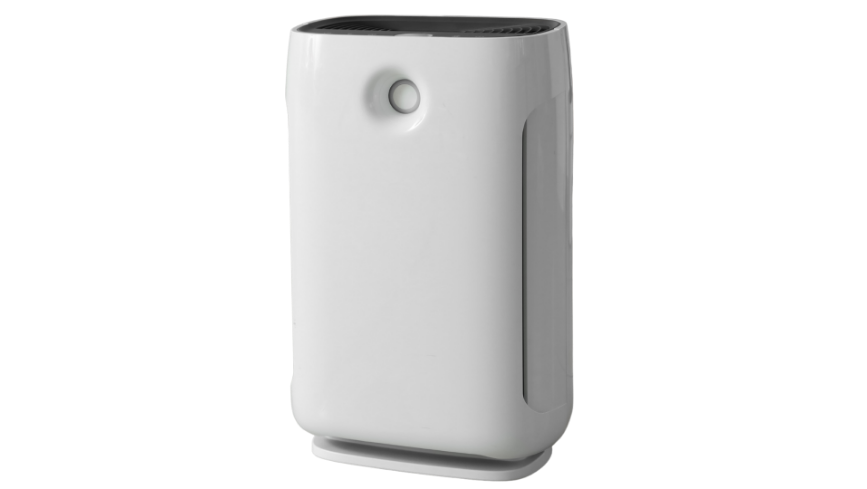
Floor-standing purifier |
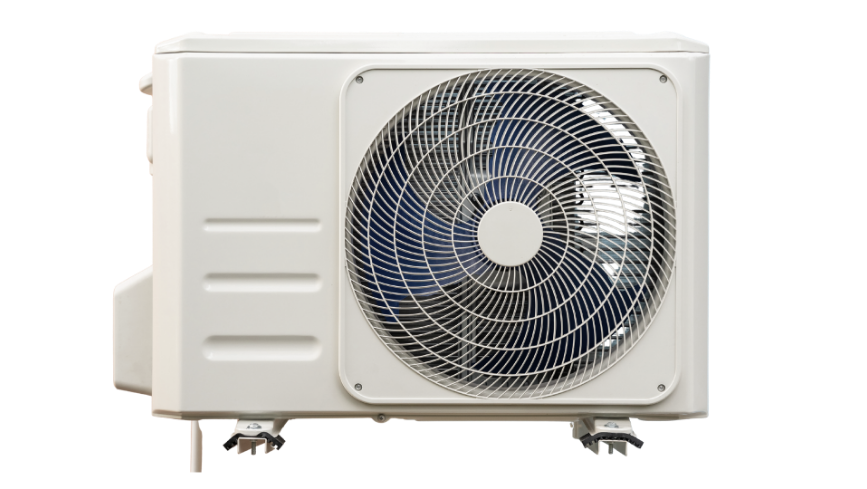
Added HVAC capacity |
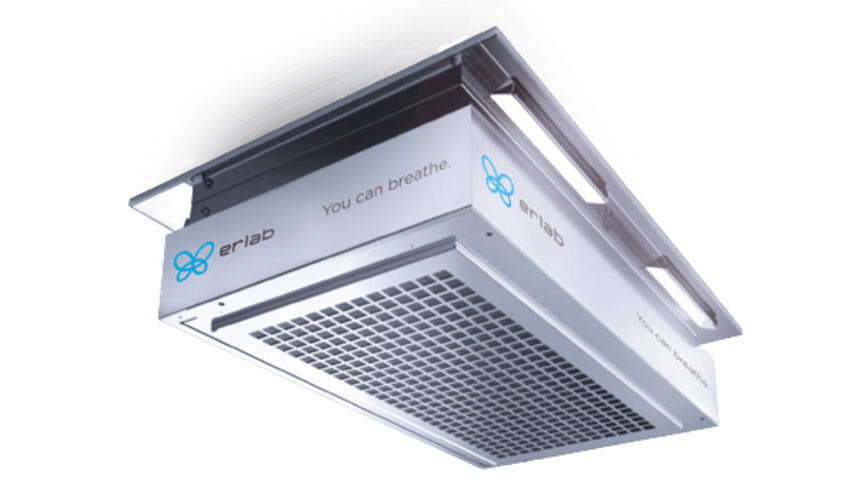
HALO ceiling air purifier |
|
|---|---|---|---|
| Treats air at | Breathing height | Duct level | The ceiling, above people |
| Floor space used | Yes | No | None |
| Building modifications | None | Yes, often $10K to $50K+ | None |
| Can be switched off by anyone | Yes | No | No, hardwired to mains |
| Spreads air through shared ducts | No | Yes | No, treated at room level |
| Filter grade | Usually H11 to H13 | MERV 13 to 16 | HEPA H14 or ULPA U17 |
| Connected monitoring | Rarely | Rarely | Yes, eGuard app and Indoorcare |
Floor-standing purifier
Specifications
Treats air at: Breathing height
Floor space used: Yes
Building modifications: None
Can be switched off by anyone: Yes
Spreads air through shared ducts: No
Filter grade: Usually H11 to H13
Connected monitoring: Rarely

Added HVAC capacity
Specifications
Treats air at: Duct level
Floor space used: No
Building modifications: Yes, often $10K to $50K+
Can be switched off by anyone: No
Spreads air through shared ducts: Yes
Filter grade: MERV 13 to 16
Connected monitoring: Rarely
HALO ceiling air purifier
Specifications
Treats air at: The ceiling, above people
Floor space used: None
Building modifications: None
Can be switched off by anyone: No, hardwired to mains
Spreads air through shared ducts: No, treated at room level
Filter grade: HEPA H14 or ULPA U17
Connected monitoring: Yes, eGuard app and Indoorcare
How the HALO ceiling air purifier works
HALO hangs from four ceiling rings and hardwires to building mains. No ductwork, no HVAC connection, installed in hours.

Air is drawn upward.
Room air is pulled into the center of the unit from below, lifting contamination away from the breathing zone where people are actually exposed.

Lab-grade filtration.
Air passes through a pre-filter and then HEPA H14, ULPA U17, or Neutrodine activated carbon, the same filter grades Erlab builds into laboratory biosafety cabinets that handle live pathogens.

Clean air returns at the ceiling.
Purified air leaves through injectors along the edges of the unit and rides the ceiling outward. The Coanda effect carries it back down through the room slowly, so the whole space keeps mixing.
A Smart-Light ring on each unit shows its status to anyone in the room, green when the air is clean, pulsing while it captures emissions, and a distinct pattern when a filter or fan needs attention. Every unit also connects to the eGuard app for remote monitoring, alerts, and fan control.
Pick the right HALO for your space
Three configurations for three contamination profiles. Add units to cover any room.
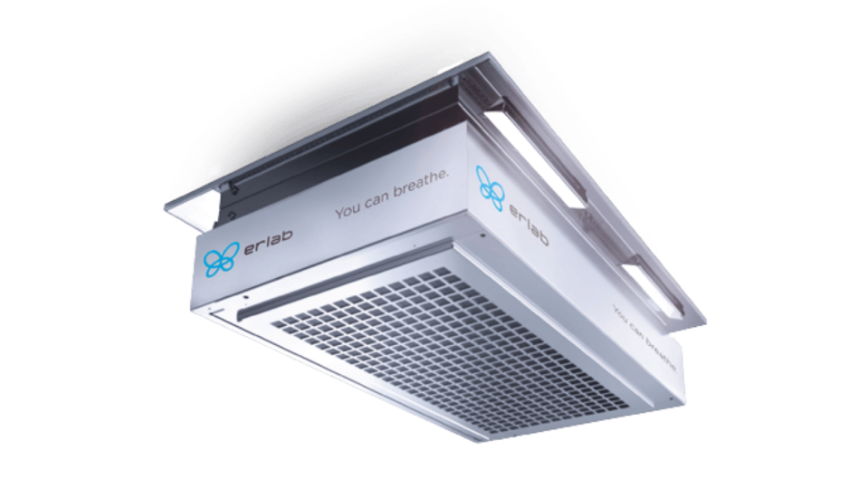
HALO 35 P Smart
|
HALO 35 C Smart
|
|
|---|---|---|
| Targets | Viruses, bacteria, mold, allergens, PM2.5 | VOCs, formaldehyde, acids, solvents, fumes |
| Filter | HEPA H14 (99.995%) or ULPA U17 | Neutrodine activated carbon, AFNOR NF X 15-211 |
| Coverage area | 376 sq ft (35 sq m) | 269 sq ft (25 sq m) |
| Airflow | 300 cu m/h (176 CFM) | 220 cu m/h (129 CFM) |
| Power | 50W | 50W |
| Built-in sensors | Smart-Light status ring | Smart-Light status ring |
| Compliance | EN 1822:2019, ASHRAE 241, UL, CE | AFNOR NF X 15-211:2009, UL, CE |
| Best for | Offices, schools, medical, care, restaurants | Labs, dental, chemical environments |
HALO 35 P Smart (particles and bioaerosols)
Specifications
Targets: Viruses, bacteria, mold, allergens, PM2.5
Filter: HEPA H14 (99.995%) or ULPA U17
Coverage area: 376 sq ft (35 sq m)
Airflow: 300 cu m/h (176 CFM)
Power: 50W
Built-in sensors: Smart-Light status ring
Compliance: EN 1822:2019, ASHRAE 241, UL, CE
Best for: Offices, schools, medical, care, restaurants
HALO 35 C Smart (chemicals, VOCs, odors)
Specifications
Targets: VOCs, formaldehyde, acids, solvents, fumes
Filter: Neutrodine activated carbon, AFNOR NF X 15-211
Coverage area: 269 sq ft (25 sq m)
Airflow: 220 cu m/h (129 CFM)
Power: 50W
Built-in sensors: Smart-Light status ring
Compliance: AFNOR NF X 15-211:2009, UL, CE
Best for: Labs, dental, chemical environments
ULPA U17 is available on the HALO 35 P for the highest-risk clinical spaces.
How HALO compares to other commercial ceiling air purifiers
Other ceiling-mounted units exist. Most come from HVAC or air-handling backgrounds. HALO comes from half a century of laboratory filtration, and it shows in the things that matter when the air actually has to be clean.

Laboratory filtration, not adapted HVAC gear. Erlab has built filtration for chemical and biological labs since 1968. The HEPA H14 in a HALO is the same grade that protects researchers from live pathogens, a step beyond the H13 found in most commercial purifiers.
Chemicals and odors, not just particles. Most ceiling purifiers filter particles only. The HALO 35 C and the Bifiltration model add Neutrodine activated carbon validated to the strictest molecular filtration standard, so VOCs, formaldehyde, and fumes are on the table too.
Certified, not just guideline-adjacent. Competitors tend to reference CDC or ASHRAE guidance. Erlab had the HALO P independently tested and certified against ASHRAE 241, the standard written specifically for controlling infectious aerosols indoors.
Proven in real buildings, not just on a spec sheet. The case studies below use calibrated particle counters in occupied rooms, dialysis centers, restaurants, a 75,000 cu ft youth center. Real reductions in real conditions, not chamber numbers under ideal settings.
How many units does your space need?
Coverage comes down to room volume and the air change rate you want to hit. Each HALO 35 P moves about 10,590 cu ft of air per hour.
Classroom
Medical waiting room
Restaurant dining
Open-plan office
Room volume
6,400 cu ft
Clean air needed
19,200 cu ft/h
HALO 35 P units
2 units
Example estimates, at the listed ceiling heights:
| Space type | Room size | Volume | Target ACH | HALO 35 P units |
|---|---|---|---|---|
| Standard classroom (8 ft ceiling) | 800 sq ft | 6,400 cu ft | 3 | 2 units |
| Medical waiting room (9 ft ceiling) | 600 sq ft | 5,400 cu ft | 4 | 3 units |
| Restaurant dining (10 ft ceiling) | 1,500 sq ft | 15,000 cu ft | 2 | 3 units |
| Open-plan office (9 ft ceiling) | 3,000 sq ft | 27,000 cu ft | 2 | 6 units |
A planning estimate only. Room shape, layout, and occupancy all affect placement, and every order includes a coverage consultation that scopes the real number for your rooms.
Measure it. Fix it. Prove it.
HALO does its best work as part of a connected program. Erlab’s three-step approach gives you the data to understand your air, the filtration to clean it, and the ongoing record to prove it to anyone who asks.

Step 1
Assess
See what is in your air. Erlab AirGradient monitors track CO2, PM2.5, VOCs, temperature, and humidity in real time, so you know what you are dealing with before you commit to a single unit.

Step 2
Address
Deploy HALO where it counts. Units go in based on the data, ceiling-mounted, hardwired, always on. Placement follows where your readings show the highest risk and the most people.

Step 3
Assure
Prove it stays clean. The Indoorcare platform delivers continuous reporting, real-time alerts, and before-and-after data for your team, your board, or your grant paperwork.
Real results in real buildings
Every figure below comes from in-situ testing with calibrated optical particle counters, not lab simulations.

Off the Vine Tuscan Grille (restaurant, Rowley MA),
80%+ particle reduction.
- Four HALO HEPA units in the dining room.
- Independent testing confirmed more than 80% reduction in fine particles during peak service, putting the room in ISO 8 cleanroom territory.

Community Chapel Church (community space, Nashua NH),
75% reduction.
- Eight HALO units in a 75,000 cu ft basement youth center with no fresh air source of its own.
- Average 75% reduction across the 0.5 to 10 micron range, the size band that carries respiratory droplets.

AUB Sante dialysis center (healthcare).
55% reduction.
- A single HALO P filtering a small dialysis room 11 times an hour.
- Post-session cleaning showed 42 to 55% reduction in 0.3 to 0.5 micron particles, measured on a calibrated KANOMAX counter.

ARE Labs (independent laboratory).
99.99% viral reduction.
- ARE Labs ran the HALO P against aerosolized MS2 bacteriophage, a stand-in for influenza and SARS-CoV-2, in a sealed bioaerosol chamber. 99.99% viral reduction inside 90 minutes, run to ASHRAE 241 protocols.
Where HALO goes to work
HALO is a commercial air purifier, ceiling mounted in the spaces where people gather and stay for hours at a time.


HALO was born in the lab. The 35 C handles analytical labs, pharma QC, and pathology spaces full of chemical fumes and VOCs, while the HEPA models guard against biological aerosols in research and clinical settings.

Classrooms, libraries, cafeterias. HALO mounts to the ceiling and hardwires in, so nobody moves it or shuts it off. Lower airborne pollutant loads track with fewer sick days and sharper focus in the room.

Open plans, conference rooms, reception areas. HALO sits above the desks and out of the way. Tied into Indoorcare, facilities teams can show employees and leadership exactly what the air looks like, day by day.

Dialysis rooms, dental operatories, waiting rooms, exam rooms. HEPA H14 at the grade hospitals use in biosafety cabinets. Dental practices often run both a HALO P for procedure aerosols and a HALO C for the fumes off dental materials.

Resident rooms, dining halls, activity spaces. The people here face the highest respiratory risk, and HALO’s hardwired, always-on operation means no gaps in protection across shift changes or staffing gaps.

Dining rooms with steady turnover and close quarters. Off the Vine is the clearest proof, more than 80% particle reduction at peak service, confirmed by independent testing.

Drills, scalers, and air-water syringes turn a routine procedure into a cloud of fine aerosol that hangs in the operatory long after the patient has left the chair. Learn more about why HALO is the right dental air purifier for your practice.
What HALO costs to run
The unit price is one piece. Here is what living with it actually looks like.
| Cost component | HALO 35 P Smart | Adding HVAC capacity |
|---|---|---|
 Installation
|
Hours, with no building work, no permits, no contractor coordination. | Weeks to months, and $10,000 to $50,000+ is common for meaningful added capacity. |
 Electricity, ongoing
|
50W continuous, about $52.60 a year at $0.12 per kWh. | Heavier fan load plus the cost of conditioning all that extra outside air, year round. |
|
Filters
|
Folded into a roughly $0.48 per day all-in operating estimate per unit. | Separate HVAC filter costs, usually quarterly or twice a year. |
 Monitoring
|
Real-time through the eGuard app and Indoorcare, included. | A separate monitoring investment to verify any of it is working. |
 Space
Space
|
None taken, it lives on the ceiling. | No added room, but you need access to the mechanical system to service it. |
The roughly $0.48 per day figure is an illustrative example covering electricity and amortized filters, based on published Erlab data. Real filter intervals shift with the environment and how busy the room is.
The questions your team will raise
| The concern | The reality | How we help |
|---|---|---|
| We already have HVAC. | HVAC runs temperature and airflow. It was not built to pull fine particles, VOCs, or pathogens out at room level. Different job, different tool. | Put AirGradient monitors in first. The data shows what your HVAC is and is not handling in your actual rooms. |
| We cannot modify our ceiling. | HALO hangs from four suspension rings. No penetrations, no ductwork, no structural work. It fits a standard drop-ceiling grid or mounts to a solid ceiling on the same rings. | A quick walkthrough confirms fit, and most installs finish in hours. |
| Will it be loud or distracting? | HALO runs at 50W from the ceiling, above the occupied zone rather than at ear level, and is built to stay quiet at its normal operating speed. | We can share acoustic specs and arrange a visit to a working install in a space like yours. |
| How do we know the filters still work? | The Smart-Light ring shows live status to the whole room, and eGuard pushes alerts to your team before any drop in performance reaches the air. | Automatic filter detection is built into every unit, so there is nothing to check by hand. |
| Coverage per unit looks small. | Units scale to any room and any shape. Eight of them cleaned a 75,000 cu ft space with no fresh air source at all. | Coverage planning comes with every order, and we specify the count and placement for your rooms. |
| Is this just a COVID product? | HALO was built for laboratories years before COVID. VOCs, CO2, PM2.5, mold, and seasonal illness are there every day of the year, virus or not. | AirGradient readings in almost any school or office show daily pollutant loads that have nothing to do with one specific virus. |
Ceiling mounted air purifier
frequently asked questions.
The basics
Is HALO a ceiling fan, or an air purifier ceiling fan?
Neither. People sometimes search for an air purifier ceiling fan, but HALO is a dedicated commercial ceiling air purifier, not a fan with a filter attached. A ceiling fan only moves air around the room. HALO pulls room air up through HEPA or activated carbon filtration and sends it back out clean along the ceiling, so it removes contaminants rather than just stirring them. It mounts overhead the way a fan does, but the job it does is a different one.
Coverage and sizing
How many units does a typical classroom need?
A standard 800 sq ft classroom with 8 ft ceilings holds about 6,400 cu ft of air. Each HALO 35 P moves roughly 10,590 cu ft an hour, so two units land near 3 air changes per hour. For higher-risk rooms, a coverage consultation sets the right count and placement for your specific layout and occupancy.
Can I use several units in one large space?
Yes, and that is how most larger rooms are handled. Community Chapel used eight units in one 75,000 cu ft space, and Off the Vine used four across its dining room. Units are placed to cover the room evenly and avoid stagnant corners.
What ceiling height does HALO need?
HALO works at standard commercial ceiling heights. The 35 P is about 12 inches deep and mounts flush. Minimum clearances and grid compatibility are on the spec sheet and confirmed during the pre-install assessment.
Installation
Does it need an electrician?
HALO hardwires to 80 to 240 VAC building mains, so the electrical connection needs a licensed electrician. Hanging the unit on its four rings is straightforward, and a unit typically goes up in a few hours. Erlab's installation service is available if your team would rather hand the whole thing off.
Does HALO tie into ductwork or HVAC?
No. HALO is fully self-contained and does not touch your ductwork or HVAC in any way. That removes mechanical coordination, duct permits, and HVAC contractors from the picture entirely.
Can it be moved later?
HALO is meant to stay put as a permanent ceiling install. Moving it is possible, but it repeats the same electrical and mounting steps as the first install. It is not a roll-around unit.
Filters and maintenance
How often do filters need changing?
It depends on the room, the occupancy, and what is in the air. Rather than a fixed calendar, HALO's Smart-Light ring and the eGuard app flag a filter when it actually needs replacing, which avoids both swapping too early and running past a filter's useful life.
Certifications and testing
What does ASHRAE 241 certification actually mean here?
ASHRAE 241 is the 2023 standard for controlling infectious aerosols indoors. Erlab had the HALO P independently tested by ARE Labs and confirmed to meet the clean-airflow requirements the standard defines. Worth being clear, as of now no US jurisdiction requires ASHRAE 241, so it works as a strong third-party performance benchmark rather than a legal box you have to check.
What standards does HALO meet?
HALO 35 P meets EN 1822:2019 for the HEPA and ULPA filters, ASHRAE 241, UL, CE, and the UK and German filtration standards. HALO 35 C meets AFNOR NF X 15-211:2009, the strictest molecular filtration safety standard, along with UL and CE.
Cost and financing
How does the cost compare to upgrading HVAC?
Adding real air changes through HVAC usually runs $10,000 to $50,000 in mechanical work, plus the ongoing cost of conditioning all that extra outside air every day of the year. HALO installs in hours and runs at 50W per unit, about $52.60 a year in electricity. All-in operating cost including filters comes to roughly $0.48 a day per unit. These are illustrative figures, not a quote.
Is financing available?
Yes. There are flexible options for institutional buyers, including short-term financing, long-term financing, and SLED lease programs for state, local government, and education buyers. We will walk through what fits your organization.
Are there grants for schools?
Yes. Several federal and state programs have funded school air quality work, including EPA indoor air quality grants and various state clean-air initiatives. We can map the sources that apply to your district and help with the paperwork. Reach out for current details.
Ready to clean up the air?
Tell us about your space and we will put together a coverage plan, a product recommendation, and pricing. No obligation, no sales pressure.
